Archive for the ‘En Chine 2009 / In China 2009’ Category

Garment Market, Sham Shui Po

Monday, October 26th, 2009

IMGP0771

IMGP0793

IMGP0773

IMGP0788

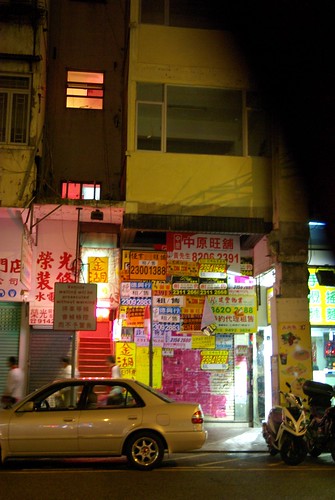
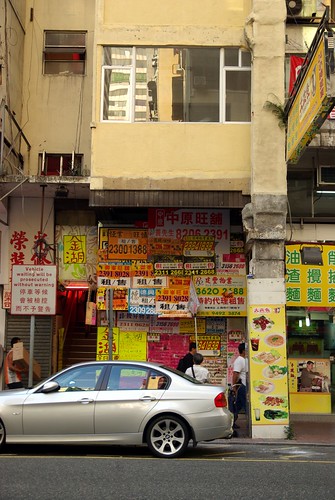
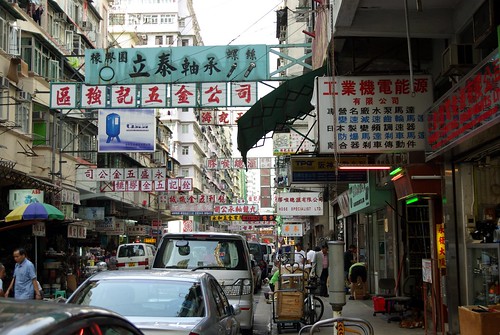
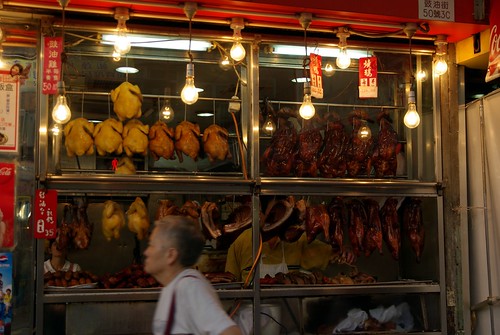
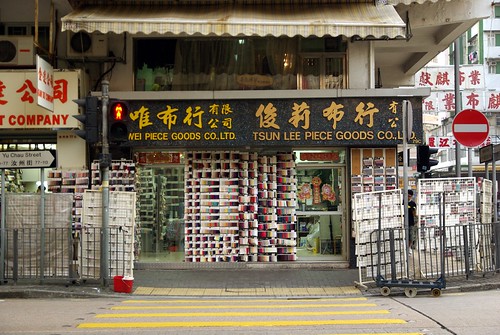
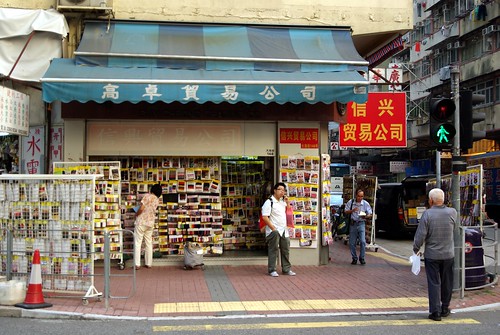
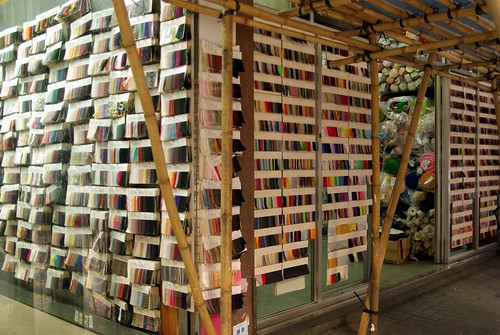
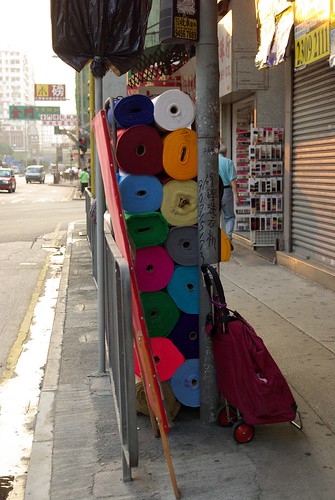
Got lost on my way to my friend’s home, near Prince Edward MTR, towards the Northwest into Sham Shui Po. In return, I found these few streets, close to the Poplar Street market, around Maple & Tai Nan, where most of the shops (if not all of them) were selling fabric, garment, textile, whoever you like to call it. Here is an approximate, non-exhaustive map:


View

Garment Street, Sham Shui Po in a larger map

Le projet du district culturel de West Kowloon

Sunday, October 25th, 2009

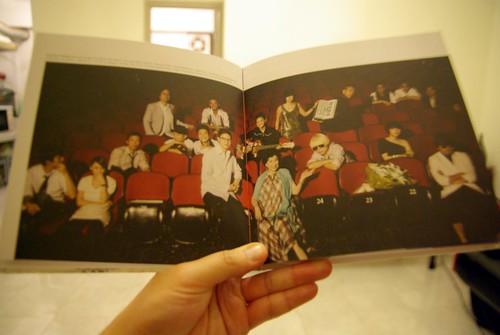
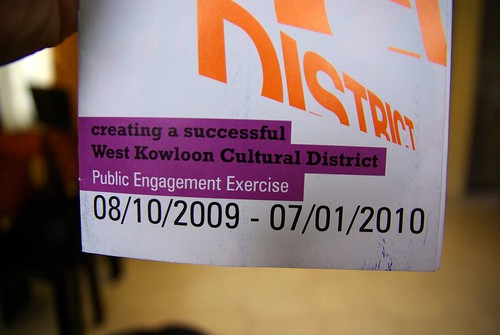
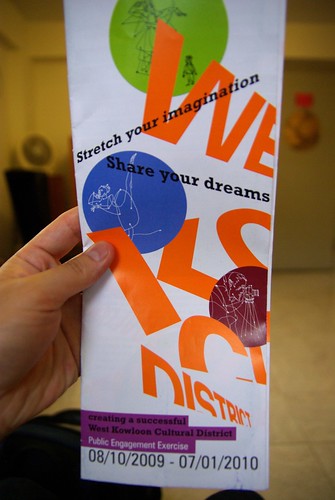
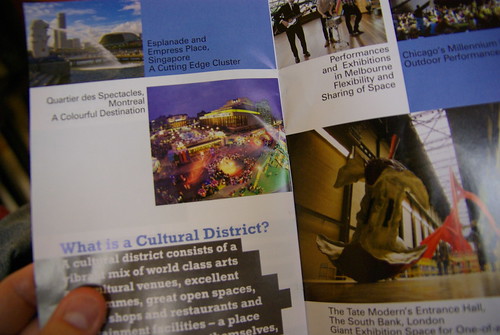
西九龍文娛藝術區 West Kowloon Cultural District - consultation pamphlet in English

西九龍文娛藝術區 West Kowloon Cultural District - consultation pamphlet in English
Dépliant du district culturel de West Kowloon, à Hong Kong

Quartier des spectacles de Montréal ! Dans le pamplet du 西九龍文娛藝術區 West Kowloon Cultural District à Hong Kong
Notre Quartier des spectacles dans leur dépliant promotionnel…

Le site officiel du district culturel de West Kowloon : http://www.wkcdauthority.hk/

Alors qu’on a le Quartier des spectacles à Montréal, Hong Kong aura le sien, qui s’appelle en anglais le « West Kowloon Cultural District ». Kowloon, c’est la pointe du continent, au sud des Nouveaux territoires de Hong Kong, et ce qu’on considère comme un des vieux districts (l’autre étant la rive nord de l’île de Hong Kong) et « centre-ville » de Hong Kong.

Comme on fait les choses en grand à Hong Kong, celui du port parfumé coûtera au secteur public une modique somme de 21.6 milliards de dollars de Hong Kong (à peu près 3 milliards de dollars canadiens). Notre Quartier des spectacles n’en a coûté que 150 millions de dollars pour les travaux de la Place des arts. C’est sans oublier le coût du remplissage (reclamation) du secteur de West Kowloon pour la toute aussi modique somme de 12 milliards (1.8 millions de dollars canadiens).

En plus d’être un district culturel (juste une opportunité de développer et d’amener de l’argent dans les coffres de l’état, diront certains), West Kowloon se veut également un futur point névralgique de transport de passagers. En effet, la future ligne express de train Guangzhou-Shenzhen-Hong Kong, qui coupe à 48 minutes la durée du voyage entre Guangzhou (Canton) et Hong Kong qui prenait auparavant deux heures, aura comme terminus West Kowloon si le gouvernement obtient ce qu’il veut. La plupart des traversiers vers des villes chinoises avoisinantes vont et viennent déjà du Hong Kong China Ferry Terminal, sur les abords du futur district culturel.

Je n’ai pas tout suivi, mais le projet de West Kowloon se veut aussi une opportunité pour les gens de se défouler et de dire ce qu’ils pensent du gouvernement sur la place publique. De ce que j’ai pu comprendre, le district culturel n’est qu’une façon détournée de créer de la terre (en remplissant du terrain de la mer) et de développer un nouveau quartier, ce qui signifie de l’argent en taxes foncières pour le gouvernement. Plusieurs groupes non-gouvernementaux, comme Designing Hong Kong, se lèvent pour avoir leur mot à dire sur West Kowloon. La nouvelle ligne de train Guangzhou-Shenzhen-Hong Kong est également une cible pour les groupes de pression, à cause des délocalisations forcées qu’elle causera.

En tout cas, si je me fie au dépliant (photo ci-dessus), le West Kowloon Cultural District ne sera pas complété avant plusieurs années…

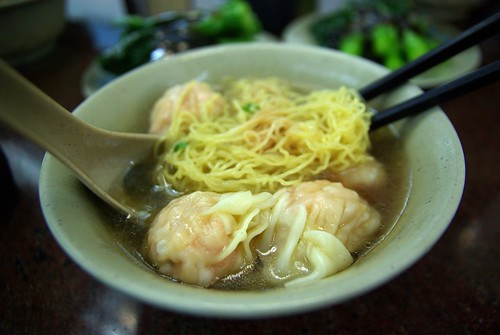
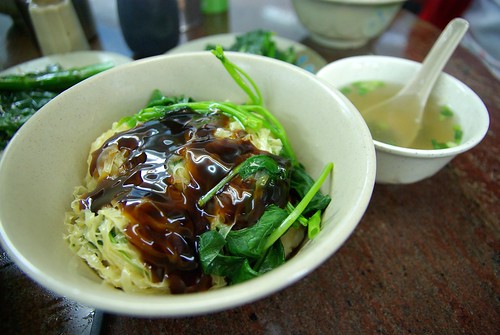
Shrimp wonton at Lung Kee Wonton 龍記招牌雲吞

Wednesday, October 21st, 2009

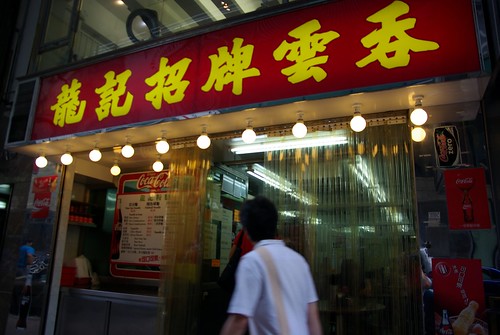
龍記招牌雲吞 Lung Kee Wonton

龍記招牌雲吞 Lung Kee Wonton

First off, I’ve no idea of the exact address. My host for the past week, who took me to Lung Kee Wonton (龍記招牌雲吞), said that it was a well-kept secret (according to him, has the best wonton in the whole city) that only Japanese publications have covered so far outside of Hong Kong.

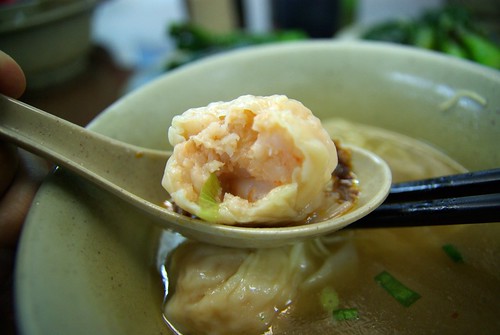
Why are its wontons so special? Because they are all-shrimp. That’s right: just the skins tightly wrapping bits of shrimp. My friend was himself taken there by a Muslim person. Wontons are usually pork and shrimp in the Cantonese tradition (those pork-only multiple-skin layers wontons at Chinese buffets are nothing but pale imitations).

龍記招牌雲吞 Lung Kee Wonton

Lung Kee’s wontons are almost like boiled har gow, so much the shrimp flavour was dominant.

Your wontons are served as wonton mein 雲吞麵, so wontons with noodles of your choice, which are the classic egg-based thin noodles , in a clear broth.

龍記招牌雲吞 Lung Kee Wonton

Better yet, you may also choose thick noodles, also egg-based. Aside from this, there is also the lou min 撈麵 or dry mix version, which is the wontons on noodles and veggies, without the broth and with oyster sauce on top. It’s slightly more expensive but it’s also for a slightly larger portion. So for the second serving, I had a combination of these two options. :)

Lung Kee is located somewhere on Carnarvon Road, across from The Masterpiece in Tsim Sha Tsui, Kowloon side. You may find another restaurant of the same name in Jordan, but that’s not the same one (pictures of its wontons also don’t match)… So, good luck finding it!

In the meanwhile, here is the menu.

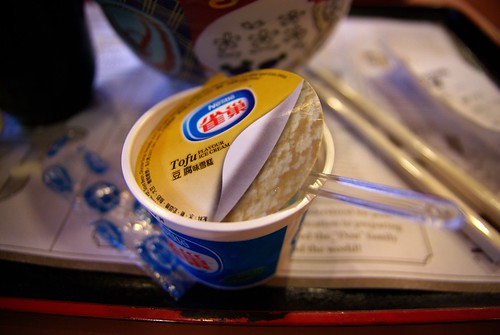
It’s tofu ice cream by Nestlé!

Tuesday, October 20th, 2009

Tofu ice cream by Nestlé!

Every time I come to Hong Kong, I notice some new “alternate” flavour of a familiar product. One time, it was McDonald’s ice cream sundae served with red bean or mango sauce (in place of strawberry or chocolate, which are also available). This time, I was eating at a Japanese chain restaurant called Yoshinoya (吉野家) and one of the dessert options for HKD$3 was… tofu ice cream, distributed by Nestlé!

It looks a lot like a vanilla ice cream. Now, what does it taste like? I would say that it was as if cow milk/cream was replaced with soy milk. So, maybe it tastes like tofu. In a land where tofu is considered as much a dessert (as doufu fa or 豆腐花), the flavour name does not sound weird at all. The other available flavour? Black sesame! (zi ma woo or 芝麻糊, the base of a well-known Cantonese dessert)

However, the one time I checked in a grocery store for these flavours, I did not find any of them under the Nestlé brand…

Le blogueur politique Wu Jiaxiang 吴稼祥 à l’école de journalisme de HKU

Saturday, October 17th, 2009

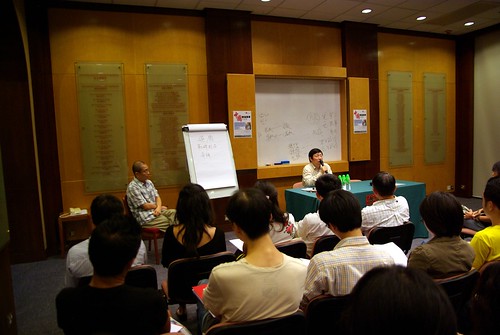
Blogger Wu Jiaxiang (吴稼祥) at the JMSC, HKU

À quoi ça peut ressembler une conférence académique à l’étranger? Pas mal la même chose qu’à la maison finalement.

Ce mercredi, je m’étais rendu sur le campus de l’Université de Hong Kong pour assister à une conférence donnée par le blogueur politique chinois Wu Jiaxiang (吴稼祥). M. Wu est un ancien adjoint du bureau de la propagande centrale en Chine, mais est un personnage connu de la blogosphère chinoise.

J’ai compris que la conférence s’intitulait « Les chances de réforme politique en Chine » et qu’il a fait un survol historique et de la situation actuelle en Chine. J’ai même sursauté quand il a mentionné les mots jia-na-da (ou Canada 加拿大), pour ensuite dire les mots kui-bei-ke (ou Québec 魁北克). C’était sans doute pour mettre en perspective les cas du Tibet et du Xinjiang, car il avait ensuite mentionné l’Écosse et la Grande-Bretagne, avant que je ne sombre à nouveau dans mon nuage linguistique. (Alors, maintenant vous le savez, de comment on parle du Québec à l’extérieur!)

La conférence a pris des apparences de montées à l’emporte-pièce, mais les étudiants n’ont rien trouvé de particulier (alors c’est juste moi et mon incompréhension de la langue, ou bien que le conférencier est bien connu pour son enthousiasme). À quelques reprises, M. Wu a bien fait rire les gens dans la salle.

Peut-être qu’on fait les choses différemment à Montréal, mais M. Wu était assis derrière une table durant presque tout son discours, tandis que le présentateur, le professeur Qian Gang (钱钢), écrivait des notes sur une feuille.

La conférence a semblé satisfaire les étudiants, qui se poussaient pour poser des questions à la fin.

四季煲仔飯 Four Seasons Pot Rice

Friday, October 16th, 2009

四季煲仔飯 Four Seasons Pot Rice

On the same night that we visited 365 Hennessy Rd, we followed our hosts to the other side of the city to Yau Ma Tei in Kowloon.

What was the occasion? The occasion was pot rice, also called po chai fan 煲仔飯 in Cantonese. Po chai fan is rice in a clay pot served with various types of meat, vegetable, seafood or condiments on top of it. In cities like Montreal, pot rice can sometimes be ordered in a Cantonese restaurant, but usually requires too much work to be considered a typical dish that people order. In Hong Kong, pot rice can be the restaurant’s specialty, as it is the case for 四季煲仔飯 Four Seasons Pot Rice.

You can think of pot rice as a style of Chinese bibim bap, with a different range of ingredients. The pot is sizzling hot and the rice and meat are still cooking when it is brought to your table. You should then add in some soy sauce and let it cook for a few minutes. While you are waiting, it is a good idea to order some side dishes, such as fried veggies or an oyster omelette:

Tung Choi at 四季煲仔飯 Four Seasons Pot Rice
Fried tung choi with foo yu sauce

Omelette at 四季煲仔飯 Four Seasons Pot Rice
Oysters omelette

The two girls who brought us here told us that the location used to be a family mom-and-pop hamburger restaurant. The current tenant has done nothing about the decoration: it’s simply a large hall covered in white tiles, with fluorescent lighting and huge fans blowing.

四季煲仔飯 Four Seasons Pot Rice

Just like La Banquise has twenty or more types of poutine, you can choose from an endless number of “toppings” for your rice at Four Seasons Pot Rice. My friends had a variety of chicken, chicken feet and other meat, while I went for a classic chicken with Chinese mushrooms.

The price for the single pot is also ridiculously low at $HKD22 for “regular flavours” (see menu), like combinations of two of Chinese sausage, salty fish, sliced pork, liver sausage and chicken.

46-58 Arthur Street, Yau Ma Tei, Kowloon (map)

365-7 Hennessy Road, Wan Chai, Hong Kong

Thursday, October 15th, 2009

上下斜睥:李香蘭上・下禾輋原稿展|Rainbow’s wo che village original show
上下斜睥:李香蘭上・下禾輋原稿展 – Exposition : Wo Che, le village de Rainbow

Le Foo Tak, au 365 Hennessy Road (j’ai aussi vu le 367) est situé à la confluence des rues Tin Lok Lane (天樂里) et Marsh Road (馬師道) avec Hennessy. Non loin de là, le tramway en provenance de Happy Valley (跑馬地) rejoint la ligne principale du tramway de l’île de Hong Kong. C’est là, à côté d’un commerce de prêt sur gage, qu’on peut trouver cet immeuble à moitié loué par des artistes.

365 Hennessy Road

Le 14e étage du Foo Tak sert (ou servait?) de quartiers généraux à la troupe du KLUUBB, un collectif d’artistes pluridisciplinaires, dont certains avaient aidé à créer Folktales From Many Lands.

L’année dernière, j’ai participé à leur événement, sans trop me rendre compte que le reste de l’immeuble (deux proprios différents, on m’a dit) était à moitié occupé par des artistes qui oeuvre dans tous les genres. Pourtant, il s’agit d’un des quartiers les plus chers à Hong Kong, sis entre le district commercial de Causeway Bay, et le quartier des affaires de Admiralty/Central.

Dessin par Rainbow Leung
Dessin par Rainbow Leung de la famille de l’artiste

上下斜睥:李香蘭上・下禾輋原稿展|Rainbow’s wo che village original show

Par hasard, lundi soir, je me suis retrouvé à nouveau dans le même immeuble, mais à l’adresse du 365 Hennessy Road. Au 1er étage, une dessinatrice dans la début vingtaine, Rainbow Leung (nom de plume “Li Xiang Lan 李香蘭), expose ses dessins au ACO, le Art & Culture Outreach.

Son oeuvre repose sur des histoires qu’elle raconte sur son village natal de Wo Che 禾輋, dans les environs de Shatin, Nouveaux Territoires. Leung dessine sa famille, ses voisins et ses amis, et a même récemment lancé un roman dessiné publié par l’un des plus grands éditeurs de Hong Kong. À chaque fin de semaine, on la retrouve dans les pages du Ming Pao 明報(disponible dans les quartiers chinois à travers le monde), alors qu’elle interviewe des Monsieur et Madame tout-le-monde avant de dessiner leur portrait.

Un de mes amis, le photographe Derrick Chang, vient de publier un essai photo sur Rainbow, pour le compte du site CNNGo. L’exposition se déroulera jusqu’à ce dimanche 18 octobre et l’entrée est libre 365 Hennessy Road, 1/F).

365 Hennessy Road
Outils de travail de Karden C

Au cours de la même visite, j’ai aussi fait la rencontre de Karden C, dont le studio se trouve au 6e étage du même immeuble. Karden, dont le nom en chinois est fa-yuen 花苑 (qui signifie jardin), partage son spacieux studio avec un danseur moderne dont le nom est incidemment siu-yuen (petit jardin).

La jeune femme se concentre sur l’art de l’estampe. Très impliquée socialement, elle a tout récemment participé à une exposition par des artistes hongkongais en mémoire du 20e anniversaire de 6/4 (événements de Tiananmen). En 2007, son estampe du Queen’s Pier (voir ci-bas) a servi d’icône au mouvement pour sa préservation qui a ultimement mené à une grève de la faim.

in the memory of Star Ferry and the Clock Tower in Central
In the memory of Star Ferry and the Clock Tower in Central, par Karden C

Le trajet en autobus vers Tai Po

Wednesday, October 14th, 2009

Eastern Island Highway
Quarry Bay 鰂魚涌

Taking the 307 to Tai Po
Eastern Harbour Tunnel 東區海底隧道

Taking the 307 to Tai Po
Kwun Tong 觀塘

Taking the 307 to Tai Po
Kowloon Bay 九龍灣

Taking the 307 to Tai Po
MegaBox shopping mall, Kowloon Bay

Taking the 307 to Tai Po
Tate’s Cairn Tunnel

Taking the 307 to Tai Po
Shatin 沙田

Taking the 307 to Tai Po 大埔
Tai Po 大埔

Une chose intéressante découlant du manque d’espace habitable à Hong Kong est que plusieurs autoroutes du « centre-ville » ont été construites sur le bord de la mer. Lundi, je m’étais rendu à Tai Po (大埔), une des « new towns » érigées dans les Nouveaux Territoires, à quelques 30 kilomètres au nord de Victoria Harbour.

Pour m’y rendre, j’ai pris la 307 qui part de Central et passe par Causeway Bay, et le trajet m’a pris environ 35 minutes sur cet autobus express. Ça m’en a coûté à peu près 25HKD$, soit 10HKD$ de plus qu’en métro et train de banlieue (mais c’est plus direct).

L’autobus a emprunté le Eastern Harbour Tunnel, l’une des trois voies routières et souterraines reliant l’Île de Hong Kong et Kowloon.

Strange blocks on Third Street

Tuesday, October 13th, 2009

Strange blocks on Third Street

Strange blocks on Third Street

Many slopes of Hong Kong have been “reformed” such as on this picture. Concrete is poured around trees and drainage holes are made to secure the slope. Each of these simili-natural concrete walls even have an identification number (I kid you not), perhaps for use by maintenance teams.

This is the first time that I take a closer look at these walls, and we notice that there are blocks protruding out of them. Someone wants to venture a theory on this one?

Temple Street, Jordan & Yau Ma Tei

Monday, October 12th, 2009

Temple Street in Jordan, HK
Temple Street à Jordan

Temple Street est une rue qui traverse du nord au sud les quartiers de Jordan (佐敦) et Yau Ma Tei (油麻地), dans la partie sud de Kowloon (九龍). Elle commence au parc de Kowloon et se prolonge vers le nord jusqu’au quartier de Mong Kok (旺角).

Dans le bout du sud autour de la rue Jordan, près du MTR du même nom, Temple Street est une rue marchande piétonnière très achalandée, pour ses boutiques de brocantes, de linge pas cher et de pseudo-iPods. Dès la fin de l’après-midi, les vendeurs qui occupent le milieu du pavé commencent à installer leurs tentes.

Comparativement aux marchés nocturnes de Taiwan, ceux de Hong Kong ont la particularité qu’on y retrouve pas de vendeurs ambulants de nourriture. Les petits vendeurs en petit chariot ont disparu de la circulation à cause de règlements municipaux liés à l’hygiène, mais d’autres qui font semblant d’être des vendeurs ambulants, en étant qu’un comptoir sur la rue, ont bien pris leur place.

Temple Street in Yau Ma Tei
Temple Street à Yau Ma Tei

Dans la partie plus au nord de Temple Street, près de Yau Ma Tei, Temple Street est encore une rue piétonnière, mais elle est aussi plus large et ses magasins se transforment peu à peu en salles de mahjong (jeu par excellence pour parier son argent) et des salles de karaoke (des lieux pour faire la pêche aux prostituées).

Au coin de Wing Sing Lane, des boutiques de vieux magazines pornos vont côte-à-côte avec d’autres qui vendent des VCD, autant de la porno japonaise que des séries d’opéra chinois, présumément piratés. Non loin de là, des hotels à l’heure; pis on se dit que ça doit bien servir un rôle social ces rues-là.

叁去壹 (Sam Hui Yat) dim sum in Sai Ying Pun

Sunday, October 11th, 2009

叁去壹點心粉麵飯

I am not generally a fan of dim sum or yum cha, the terms usually used interchangeably to describe a Chinese brunch popularized by the Cantonese (and exported to the West by them). Dim sum literally means “bite heart” or “touch the heart” says Wikipedia, while Yum cha literally means “drink tea” and describe the activity of relaxing around a cup of tea (and eating dim sum, sometimes).

I’ve typically only eaten in large dim sum halls, here in Hong Kong as well as back home in Montreal. In Hong Kong, family would bring me to restaurants with overly nice decors. However, my tastes tend to range around the “beau, bon, pas cher”, a French expression from home that basically means “nice, good, inexpensive”.

叁去壹點心粉麵飯
叁去壹(點心粉麵飯) = Sam Hui Yat = Three Goes One

叁去壹點心粉麵飯
Steamers

From the tram stop in Sai Ying Pun (西營盤), we walked only a few minutes to get to 叁去壹 (Sam Hui Yat – something like Three Goes One). Located at the very beginning of Pokfulam Road (corner with First St), which eventually leads to the University of Hong Kong, some 200m up the hill, the restaurant is in fact an unassuming eatery, with no more than a dozen tables for about 30 clients at once. It was a far cry from what I imagined, perhaps because I’ve always been used to being served dim sum in large restaurants (here in Hong Kong, restaurants with carts also virtually don’t exist anymore).

I originally horribly missed my first occasion to eat here with Chinese speakers and on the time that I actually went, I was only with my non-Chinese-speaking friend. Why is that so important? Because there is not a single English character in the entire restaurant! Unable to get a good hold of the menu, I resorted to asking the waiter, who was very patient and cordial in helping me out. After listening to the chef’s suggestions, I decided to go for sure bets, namely siumai (燒賣 – seasoned ground pork in wrapper), har gow (蝦餃 – shrimp dumpling) and steamed black-bean spare ribs (豉汁排骨). It’s also a surcharge of $HKD3 for tea per person.

For the record, the siumai was juicy inside and the har gow’s shrimp crunched right under one’s teeth and the ribs were very tender. Don’t feel intimidated by the “minimalistic” setting, because the food is in fact excellent.

At the front of the restaurant was the “steamers station”, where the chef (the guy in a red sleeveless shirt) presumably steamed orders of dumplings and other dim sum. The order came very quickly, as you’d expect for a diner. To pay, don’t necessarily expect the waiter to give you the bill: just hand him the money as if you knew the total price and he will count the number of steamers (they are invariably $HKD9) or lotus leaves that you have spread out in front of you. It’s also a surcharge of $HKD3 for tea per person.

叁去壹點心粉麵飯
Menu (click for translation notes on Flickr)

Of course, the menu is all in Chinese, and there is another menu in the restaurant that is for non-dim sum dishes, such as fried rice and noodles. Aside from those aforementioned, Sam Hui Yat has a complete lineup of dim sum classics: fong zao (鳳爪 – chicken feet), chiu chow fun go (潮州粉果 – Chaozhou-style dumplings), char siu pao (叉燒包 – pork bun), lo mai gai (糯米雞 – lotus leaf chicken rice) and a variety of cheong fun (腸粉 – rice rolls).

Har Gow - 叁去壹點心粉麵飯
Har Gow (蝦餃)

Siumai - 叁去壹點心粉麵飯
Shaomai (燒賣)

It is to be noted that the restaurant closes at 2:30PM in the afternoon. To get there, the easiest way is to take the tram going west from Central or Sheung Wan MTR (take the trams going to Whitty Street Depot or Kennedy Town). Then, walk up the slope on Western St., until you get to Pokfulam Road.

11 Pokfulam Road, Sai Ying Pun, Sheung Wan (map)

Automated protest in front of the Citibank in Central

Sunday, October 11th, 2009

Automated protest at CitiBank in Central, HK

Automated protest at CitiBank in Central, HK

Automated protest at CitiBank in Central, HK

Automated protest at CitiBank in Central, HK

Ah Hong Kong, you never cease to amaze me. These are pictures taken in Central, the city’s main international business area, in front of the local Citibank branch. A protest is going on: the people who instigated it are asking Citibank for compensation for failed financial products that they bought, namely something called equity-linked note

But where are the protesters?

Answer: well, on this occasion, they were there and distributing fliers while a loudspeaker blurted out anti-Citibank slogans. But days earlier when I passed by, they were not. And actually, on that day, the whole protest was automated, while the protesters went for lunch or something!

Here is an audio recording that I made with a lady who was nice enough to explain the situation (in Cantonese — okay, I did not get a word of what she said):
http://commeleschinois.ca/media/ds400194.wma

The lady told me that their group has a website: http://www.lbv.org.hk/

榕樹灣 (Yung Shue Wan), Lamma Island

Saturday, October 10th, 2009

Yung Shue Wan, Lamma Island

Last Sunday, I visited Lamma Island (南丫島) with some friends who wanted to go to the beach. At around 10km between its northern and southern tips, Lamma is one of the said “outlying islands” of the Hong Kong SAR. It is located directly southwest of the much larger (10-15 times in terms of area) Hong Kong Island, opposite the locality of Aberdeen (Hong Kong Chai).

Ferries to Aberdeen and to Central are available at two different piers on the island. We took the one from Central that served the most populated area, the village of Yung Shue Wan (榕樹灣) in the northern part of Lamma. The boat ride took 25 minutes and we got off and were in a small little village, reminiscent of the one I visited in Cheung Chau (if you’ve been there — it’s another “outlying island”).

Yung Shue Wan, Lamma Island

We set off to walk the entirety of the island, to reach the second port in the east. The trail being 5-10 km long, we never actually made it there. We stopped along the way to get fresh tofu dessert, before reaching the beach at sunset for a fantastically warm swim.

All you need is love - 榕樹灣 (Yung Shue Wan)

I returned to Lamma yesterday, to bring a friend from Montreal who was on his first trip to Hong Kong, to show him the marvels of the rural Hong Kong. We ate at one of the local seafood restaurants — so either I should’ve chosen my fish or ordered the grouper instead.

We had a red snapper steamed with soy sauce and scallions. It wasn’t extremely bad, but clearly did not satisfy my craving for Cantonese-style fish, the ginger & scallions fish that some call the perfect dish with the distinct Cantonese taste. While the snapper relieves you of $HKD170, the grouper is yours only if you’re willing to fork out $HKD300. Even if my stomach thought otherwise, my budget tourist wallet had the last call. The tung choi was pretty enjoyable.

Red Snapper + soy sauce + scallions

榕樹灣 (Yung Shue Wan) + coal power plant

So this would be my second time in Lamma, but I am already considering it the top place where I want to say. It would be pretty ironic that while I lived with the most “Hong Kong” view in Montreal (opposite Cité du Parc), that I would consider moving one of the least “Hong Kong” places in Hong Kong.

One last note about the island is that it is car-free. Yep, so no real motorized vehicles are allowed on the island! most people go about on foot or by bike (being a fervent cyclist, I was hoping not to lose the habit in Hong Kong). On the other hand, look at the previous picture. Do you notice the huge chimneys with a plume of black smoke coming from one of them? This is the first instance of a coal power plant that I am seeing with my own eyes… Not quite as smoky as the ones in SimCity, but still rather scary. Apparently, this plant powers Hong Kong Island, Ap Lei Chau and Lamma. There is a wind turbine too.

SOGO crossing, Causeway Bay, Hong Kong

Wednesday, October 7th, 2009

SOGO crossing, Hennessy Rd., Causeway Bay (1 of 4)

SOGO crossing, Hennessy Rd., Causeway Bay (2 of 4)

SOGO crossing, Hennessy Rd., Causeway Bay (3 of 4)

SOGO crossing, Hennessy Rd., Causeway Bay (4 of 4)

L’intersection du SOGO – du nom du grand magasin dominant ce coin de rue – est probablement l’un ou le lieu le plus cher à Hong Kong en termes d’affichage publicitaire. La confluence d’au moins cinq rues différentes, celui-ci rivalise en achalandage avec l’intersection de Shibuya à Tokyo ou Times Square à Manhattan.

The SOGO intersection, named after the department store dominating it, is probably Hong Kong’s most expensive spot for billboards. At the confluence of at least five different streets, it rivals in traffic with Tokyo’s Shibuya crossing or Manhattan’s Times Square.

Hong Kong ce soir

Tuesday, October 6th, 2009

View of HK (from Tai Hang)

Voici la vue de la fenêtre de chez ma tante à Hong Kong. Je l’ai prise vers 18h ce soir. / This is a view from my aunt’s place in Hong Kong. I took this at around 6PM this evening.