Le Journal de Montréal, Chinese-style

Posted on

Pour ce qui est de la page couverture choc, les journaux chinois ne font définitevement pas dans la dentelle. L’un des quotidiens chinois souvent cités pas les blogs Danwei et EastSouthWestNorth, le Southern Metropolis Daily (南方都市报) basé à Guangzhou (Canton) fait sa une d’aujourd’hui avec un carambolage monstre survenu dans l’ouest de la province méridionale … Continue reading “Le Journal de Montréal, Chinese-style”

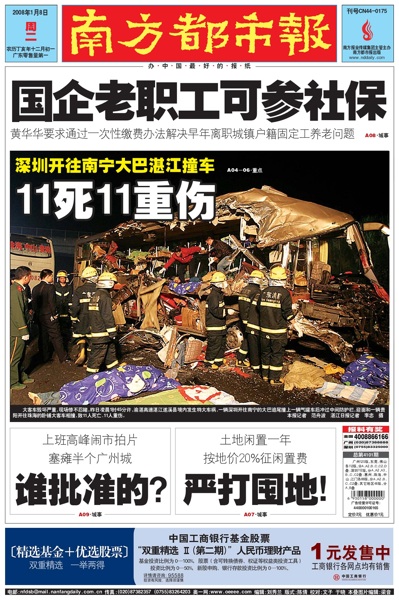
Nan Fang Du Zhi Bao - Bloody pileup in Guangdong province

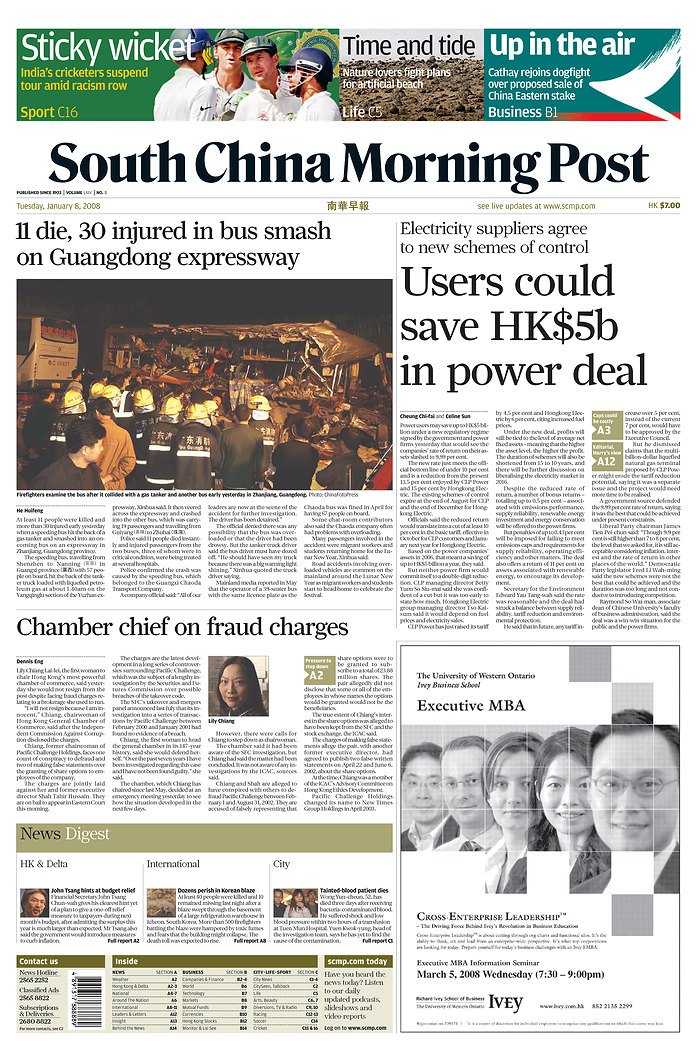
Pour ce qui est de la page couverture choc, les journaux chinois ne font définitevement pas dans la dentelle. L’un des quotidiens chinois souvent cités pas les blogs Danwei et EastSouthWestNorth, le Southern Metropolis Daily (南方都市报) basé à Guangzhou (Canton) fait sa une d’aujourd’hui avec un carambolage monstre survenu dans l’ouest de la province méridionale du Guangdong. En grosses lettres style Journal de Montréal, on peut y lire en chinois “11 morts, 11 blessés”, même si dans l’article de Danwei, on rapporte en fait qu’un des morts n’était que blessé (le SCMP rapporte 11 morts, 30+ blessés). La photo, elle, est en langue universelle…

With respect to shocking front pages, Chinese newspapers definitely aren’t novices. One of the Chinese newspapers frequently cited by blogs Danwei and EastSouthWestNorth, the Southern Metropolis Daily (南方都市报) based in Guangzhou does its front page with a gigantic pileup that occurred in the west of the southern province of Guangdong. In big letters, Journal de Montréal-style, it reads in Chinese “11 deaths, 11 injured”, even though in Danwei’s article, they revised that one of the dead was not (the SCMP says 11 dead, 30+ injured). The photo, on the other hand, is in universal language…

Eve & the Fire Horse à Montreal, 19 janvier 2008

Posted on

Eve and the Fire Horse (2005), de la réalisatrice canadienne d’origine chinoise Julia Kwan, sera présenté le samedi 19 janvier 2008 à 19 h à la Cinémathèque Québécoise (335, boul. De Maisonneuve Est, métro Berri-UQAM, sortie Maisonneuve). Il s’agit de la première des projections mensuelles de films asiatiques organisées par l’organisme Ciné Asie fondé par … Continue reading “Eve & the Fire Horse à Montreal, 19 janvier 2008”

Eve and the Fire Horse

Eve and the Fire Horse (2005), de la réalisatrice canadienne d’origine chinoise Julia Kwan, sera présenté le samedi 19 janvier 2008 à 19 h à la Cinémathèque Québécoise (335, boul. De Maisonneuve Est, métro Berri-UQAM, sortie Maisonneuve). Il s’agit de la première des projections mensuelles de films asiatiques organisées par l’organisme Ciné Asie fondé par Mi-jeong Lee (elle est aussi connu comme étant la co-programmatrice du volet asiatique du festival Fantasia). Un atelier gratuit sur le maniement de la caméra est également présenté à partir de 17 h.

Eve and the Fire Horse (2005) by Chinese Canadian director Julia Kwan will be presented on Saturday January 19th at 7pm at the Cinémathèque Québécoise (335, boul. De Maisonneuve Est, métro Berri-UQAM, Maisonneuve exit). This is the first monthly asian film screening organized by Mi-jeong Lee’s Ciné Asie (she is also known as the associate programmer for Fantasia‘s Asian section). A free workshop on camera handling is also presented starting at 5pm.

Facebook: http://www.facebook.com/event.php?eid=9798535990

Chinese pork and vegetable dumplings

Posted on

One of the recurrent social activity involving food in my circle of friends, has been dumplings-making. In certain families, preparing dumplings (or also wonton) is something that you do every year during the Chinese New Year period. There is no such tradition in my family, although the chain-production of wontons by my father is something … Continue reading “Chinese pork and vegetable dumplings”
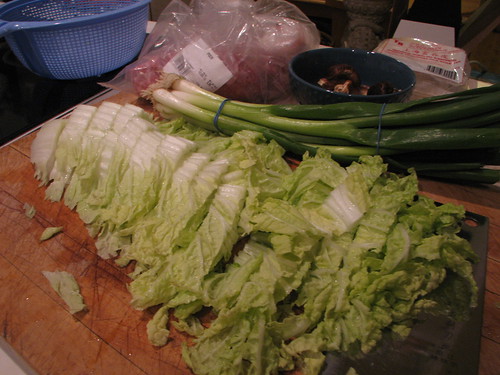
Chinese pork dumplings: the ingredients

One of the recurrent social activity involving food in my circle of friends, has been dumplings-making. In certain families, preparing dumplings (or also wonton) is something that you do every year during the Chinese New Year period. There is no such tradition in my family, although the chain-production of wontons by my father is something that seems to return every year or so.

Sometime last week, I had my friends over, and we prepared three different bowls of mix for Chinese-style dumplings, or 餃子 (jiaozi) in Chinese. One first friend, an international student from Sichuan, made a “traditional” mix, which did not contain anything but ground pork, seasoning, sesame oil and corn starch. My other friend, a Chinese Canadian originally from Hong Kong, who has a kick for cilantro, made a mix with ground pork, mashed nappa cabbage, green onions, seasoning, sesame oil, and a lot of coriander. My recipe, as seen on the picture (actually taken during a practice run, a few days earlier), consisted of the same thing as the previous friend’s, but without the cilantro, and instead with Chinese mushrooms (commonly known as shitake in the West), dried scallops.

I am not a fan of wontons, perhaps because we always had them, rather than dumplings. The difference is that dumplings have a thicker skin, and you can thus fry them in a pan. After wrapping our dumplings in varying shapes (which is the real fun part), we cooked them in two different ways:

  • The first method was to throw them into a pot of scalding hot water, boil them for a while, and then interrupt the cooking by adding cold water. This is considered the “standard” method.
  • The second method, maybe more tasty, but not as good for your health and a little high-maintenance. It requires you to directly put your dumplings over a pan with oil, fry them for ~5 minutes until the dumplings become crispy and brown, and then go through the non-intuitive step of adding water or broth to cover about 1/4 to 1/3 of the dumplings height. This is to cook the dumplings entirely. After boiling off the liquid, you would fry the dumplings some more for an extra crisp.

Ironically, we used wonton wrappers (Shanghai kinds) instead of dumpling ones. Because wonton wrappers are thinner, they are also more fragile and prone to breaking, after absorbing extra moisture from the meat filling.

Le Quartier Chinois de Montréal en 1984

Posted on

Il a presque fallu que je torde un bras à mon père pour qu’il mette ces photos sur Flickr, et ça en a vraiment valu la peine. Depuis le Boxing Day, il a passé le plus clair de son temps à scanner nos diapos de famille, incluant quelques unes du Quartier Chinois de Montréal en … Continue reading “Le Quartier Chinois de Montréal en 1984”

Boulevard St-Laurent 1984

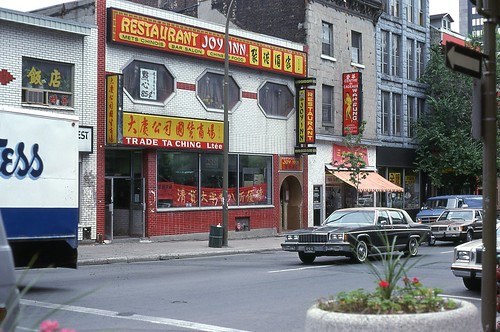
Il a presque fallu que je torde un bras à mon père pour qu’il mette ces photos sur Flickr, et ça en a vraiment valu la peine. Depuis le Boxing Day, il a passé le plus clair de son temps à scanner nos diapos de famille, incluant quelques unes du Quartier Chinois de Montréal en 1984. La première ci-dessus nous montre le bloc sur St-Laurent, just au sud de De La Gauchetière, où se trouve présentement la rôtisserie et déli chinois, avec les escaliers desservant le sous-sol de l’immeuble en moins. Le restaurant Joy Inn au deuxième étage fait la publicité de ses portions de dim sum pour aussi peu que $0.85, tandis que le magasin de cadeaux Wah Fung a déjà pignon sur rue, avec un Bruce Lee dessiné sur son enseigne rouge et jaune.

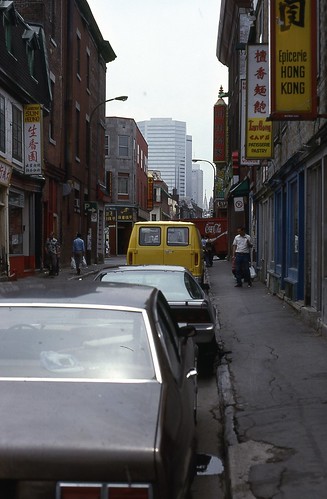
Hong Kong existait déjà en 1984, mais était autrefois une épicerie sur De La Gauchetière, entre St-Laurent et St-Dominique, se rappelle mon père. Le magasin appartenait à la famille 馬 (Ma), qui possédait également la poissonnerie et boucherie Kowloon. Les deux magasins se trouvent sur le côté droit de la rue sur la prochaine photo, et déménagèrent sur St-Laurent quelques années plus tard, là où mes souvenirs d’enfance se rendent.

Rue de la Gauchetière au Chinatown 1984

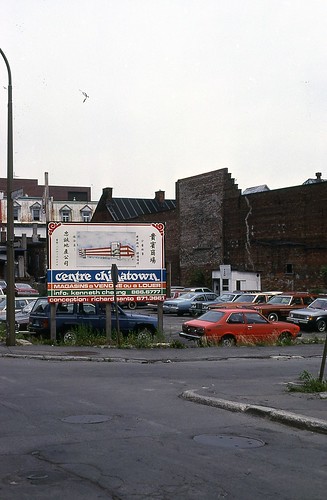
1984 fut également l’année d’inauguration de deux nouveaux projets d’habitation au Quartier Chinois, un sur St-Urbain et Dorchester (maintenant René-Lévesque) et un autre sur St-Dominique et De La Gauchetière. D’un autre côté, d’autres projets de contruction, comme le “Centre Chinatown” (voir prochaine photo), au-delà de l’emplacement présent de la porte est du Quartier Chinois, n’ont jamais vu le jour et disparu de l’imaginaire des gens.

Rue de la Gauchetière et Rue Anderson 1984

An English version of this article was published on Spacing Montreal.