Archive for the ‘Société / Society’ Category

What $200 Will Buy on Shanghai Street

Thursday, March 13th, 2008

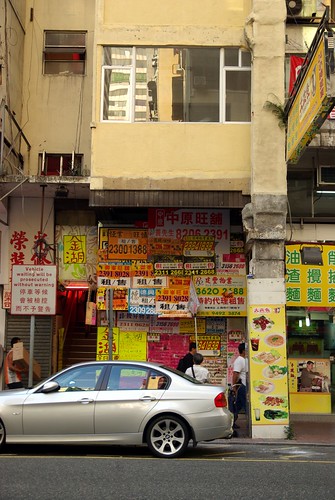
Brothel on Shanghai Street, by christopher dewolf

Read my update (2009-11-03): What will $200 in fact still get you on Shanghai Street?

Brothels in Hong Kong are pretty obvious, even to the untrained eye. In 2002, on my first trip to Hong Kong, I was told by relatives to well differentiate between karaoke bars and music boxes (the latter being the one that you go to with family and young children). In 2005, when I decided to walk on my own in the streets of Hong Kong, I finally realized that they might just be part of the background, almost as if it were just any other “service”.

My friends Chris and Laine are apparently having a great time in Hong Kong, eating well, wandering in a lot of places. Yesterday, Chris posted a pair of articles on Urbanphoto, including a piece on the brothel area on Shanghai Street, around Yau Ma Tei and Jordan:

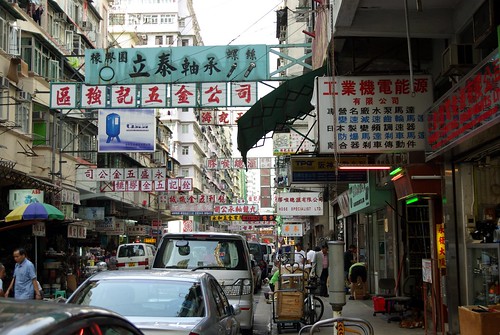
Shanghai Street is one of those long, straight Kowloon roads that seem to change character every few blocks. In the south, near Jordan Road, are grocery stores and restaurants, along with a handful of shops catering to Nepalese, Indian and Pakistani immigrants. In the north, past Argyle Street, home furnishing stores predominate. The red light district falls somewhere in between.

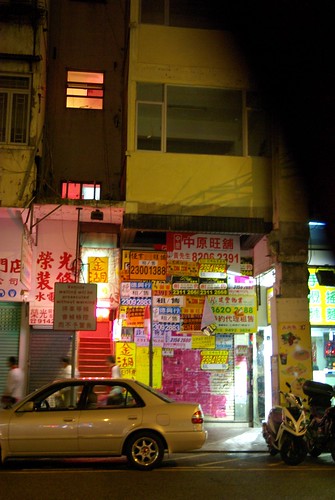
For the most part, brothels in Yau Ma Tei and Mongkok are coyly disguised as “karaoke bars,” their real vocation indicated by the pretty, busty girls on their signs, often accompanied by a price. On Shanghai Street, though, the sex trade is as blatant as it gets in Hong Kong, with hookers waiting on the sidewalk and brothels that do away with all pretense of offering karaoke and instead unabashedly advertise their real wares. Here, racism and sexism come together in cardboard signs posted at the entrances to old walkup apartment buildings: “China Girl 250; Hong Kong Girl 250; Malay Girl 200; Russian Girl 550; Free Preview.”

It’s a bit of a shock to see these signs displayed so openly, especially since most aspects of prostitution, including the operation of a brothel, are illegal in Hong Kong. It is hard not to read into them a mirror of the more unsavoury side of Hong Kong society, one that is often shameless in its contempt for the 300,000 Filipina and Indonesian domestic helpers that live and work in the territory.

Yesterday, on the bus, my girlfriend overhead a couple ranting about the gall their helper had in asking for time off to visit her sick mother in the Philippines. “What, does she think that she’ll get better if she goes to visit?” one of them said, before complaining about her eating habits. “Some of those damn Filipinas eat so much.” With attitudes like that, is it any surprise that such a low value is placed on women, and in particular Southeast Asian women, on Shanghai Street?

But the red light district on lasts for only a few blocks; it’s easy to walk past and, if you want, easy to forget.

This article was originally posted by Christopher DeWolf on the collaborative blog Urbanphoto, which he runs.

Chinese Canadians in the CBC Digital Archives

Monday, March 10th, 2008

CBC Archives topic on Chinese immigration to Canada

It is mostly old contents, but on a newly redesigned/rethought CBC Digital Archives website, launched today with its sister project, the Archives de Radio-Canada. There is among other things a very interesting topic on Chinese immigration to Canada with 20-something clips from the Canadian Broadcasting Corporation’s television and radio archives.

C’est en grande majorité du vieux contenu, mais sur un tout nouveau site reconceptualisé/repensé des Archives de Radio-Canada lancé aujourd’hui en compagnie de son jumeau, le CBC Digital Archives. Il existe entre autres un intéressant dossier sur l’immigration chinoise au Canada, avec une vingtaine de clips provenant des archives audio et vidéo de la Société Radio-Canada (incluant un reportage entier sur Honkouver (sic)).

Eugene Yao, 1946-2008: A Chinese Activist

Monday, February 25th, 2008

Eugene Yong Ging YAO - 1946-2008

Eugene Yao was born in Shanghai in 1946, and came to Canada in 1969 as a student of McGill University in electrical engineering, where he met his wife-to-be, Winnie Ng, a sociology student. He was later president of the Chinese Canadian National Council. In recent years, he became known for starting a commuter bicycle shop in Toronto called The Urbane Cyclist. (Toronto Star | Activist Magazine)

My friend Bethany knew him personally and this is what she had to say about Yao:

Eugene was the most generous, kind-hearted person you could imagine. He was a forward-thinking man, and decided to leave traditional employment behind. He was married to Winnie Ng, well-known NDPer and immigrant- labour-rights activist in Toronto. They let me stay at his house for a month when I was working in Toronto and refused to let me pay them a cent, loved by all my friends who were clients of Urbane Cyclist.

I had just got my bike stolen when I moved in with them and Eugene kindly supplied me with a sturdy old beater for the month! Of course, it ran like a dream….

Interracial relationships and Shortcomings

Friday, February 22nd, 2008

Shortcomings - Miko

Organized jointly by the Chinese Family Service of Greater Montreal and the New Voices Project (Montreal), Interracial relationships and Shortcomings is an open discussion stemming from a reading of Japanese-American Adrian Tomine’s graphic novel Shortcomings. This will be held on this coming Sunday, 4PM, at the CFSGM (987, Rue Côté) and is open to everyone. You don’t even need to have read the book to be able to fully participate in the discussion! English and French, and special refreshments will be served.

Organisé conjointement par le Service à la Famille Chinoise du Grand Montréal et le Projet Nouvelles Voix, Relations interraciales et Shortcomings est une discussion ouverte découlant de la lecture de la bande dessinée Shortcomings de l’Américain d’origine japonaise, Adrian Tomine. Ça aura lieu ce dimanche, 16 h, au SFCGM (987, Rue Côté) et c’est ouvert à tous ! En français et en anglais, et on servira une collation spéciale.

Facebook event: http://www.facebook.com/event.php?eid=10210172274

(Oh yeah, and Adrian Tomine is coming to Montreal next Tuesday. / Ah oui, pis Adrian Tomine s’en vient à Montréal mardi prochain.)

Très naïve, très stupide: une révolution par le bas

Wednesday, February 13th, 2008

Gillian Chung

Depuis seize jours que le scandale de photos explicites impliquant Edison Chen, chanteur, acteur, idole, et des artistes féminines très connues de Hong Kong fait rage dans le monde sinophone. Vancouverois d’origine, Chen, 27 ans, se serait fait subtiliser des photos et vidéos de son Macbook rose lors d’une opération d’entretien. D’une certaine manière, il a confirmé que c’était bel et bien ses photos en postant une vidéo la semaine dernière sur son blogue personnel (en anglais bien West Coast).

Mon site favori de nouvelles traduites en anglais, ESWN, couvre admirablement bien ce que les médias sinophones racontent sur le scandale. Dans ses mots, l’auteur du blogue, Roland Soong, un résident de Hong Kong qui a vécu 32 ans auparavant aux États-Unis, décrit comment même la crise du SRAS en 2003 n’avait pas réussi à monopoliser une si grande attention médiatique. Depuis seize jours consécutifs, le scandale fait la une des grands journaux de Hong Kong.

Dans les médias locaux, on est loin de faire dans la critique vide. Un éditorial publié dans le Apple Daily, genre de Journal de Montréal avec une certaine crédibilité journalistique, et s’accaparant le deuxième rang au niveau des copies vendues à Hong Kong, fustigeait la starlette Gillian Chung du duo pop Twins (à gauche sur la photo) pour ses prises de position pour la chasteté, pendant qu’elle se retrouvait les quatre fers en l’air avec Chen. L’auteur tente de démontrer que la vie privée des personalités publiques devenait l’affaire de tout le monde au moment où ils utilisent leur célébrité pour faire avancer des idées sur la place publique, comme c’était le cas de Chung.

Cette sorte de réaction n’est sans trop se rappeler l’affaire du « Très jaune, très violent », alors qu’une étudiante du secondaire déclara cela sur les ondes de CCTV à propos de choses qu’elle aurait trouvé sur le web. Une foule netcitoyenne hostile s’était soulevée, écorchant à la fois la jeune fille de façon sauvage, mais également la culture de l’aseptisé qui domine la société chinoise. Chung déclairait être « Très naïve, très stupide » lors de sa première apparition en public depuis que l’affaire n’éclata. À la différence que ce qu’on discute surtout en ligne, dans les médias non officiels en Chine, à Hong Kong, on se permet de le faire au grand jour.

Ce n’est pas tellement que les Chinois sont plus prudes ou quoi que ce soit, mais bien que tout le monde est aussi sensible à l’hypocrisie, qu’on soit en Amérique ou en Chine. Britney Spears vs. Paris Hilton : l’une de ces carrières vole plus haut que l’autre.

Si cette histoire intéresse tellement de gens, c’est bien sûr d’abord et avant tout parce que le sexe, ça vend, surtout quand c’est des célébrités. Mais si on découvre qu’Edison Chen était de connivence avec la publication des photos, alors on pensera que c’est un autre Chinois d’outre-mer (comme Daniel Wu, avec Heavenly Kings) complètement tanné de vivre dans le monde super-photoshoppé du divertissement populaire de Hong Kong.