Dim sum à deux mondes opposés
Posted on新興食家 San Hing Sek Ka, Kennedy Town, Hong Kong Tong Por, Ville Saint-Laurent, Montréal

新興食家 San Hing Sek Ka, Kennedy Town, Hong Kong Tong Por, Ville Saint-Laurent, Montréal
Boulangerie Donq à Causeway Bay, Hong Kong On dira ce qu’on voudra, mais le pain à Hong Kong… est fait au goût des Hongkongais. Ainsi, plus souvent qu’autrement, le pain que je mange à Hong Kong, c’est le pain tranché, marque Garden, communément appelé Garden Bread. Les miches sont hautes et font de grandes tranches. … Continue reading “Un pain moelleux et dense à Hong Kong, est-ce possible ?”
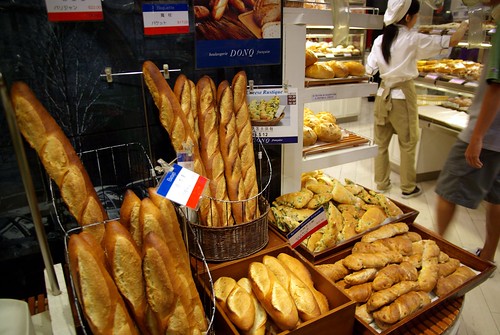
Boulangerie Donq à Causeway Bay, Hong Kong
On dira ce qu’on voudra, mais le pain à Hong Kong… est fait au goût des Hongkongais. Ainsi, plus souvent qu’autrement, le pain que je mange à Hong Kong, c’est le pain tranché, marque Garden, communément appelé Garden Bread. Les miches sont hautes et font de grandes tranches.
Ceci est un exemple de pain tranché fait dans une petite boulangerie locale, Electric Road à Tin Hau:
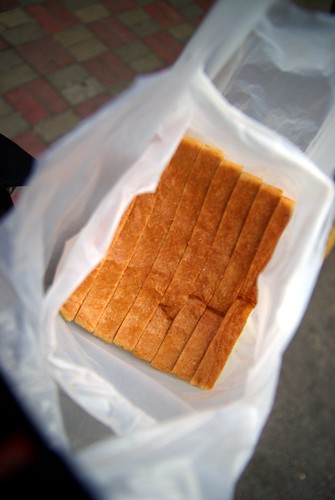
Pain style « Garden Bread », dans North Point
C’est du pain tranché, alors bon, pour à peu près 10$HK (1,30$CA) la miche (qui nous dure 5 jours pour une personne), on ne s’attend pas à trop… Il a un goût doux et quelque peu pâteux. Peut-être même qu’on y met un peu de poudre de lait.
Little Mermaid: le plus facile à se procurer
Alors dans les pains un peu plus sophistiqués, qu’avons-nous à mettre sous la dent ? Il y a d’abord la boulangerie Little Mermaid, qui est la plus facile d’accès en général. C’est une boulangerie japonaise (voir site du Japon), mais qui a quatre petits magasins dans des supermarchés city’super. Le pain est malheureusement beaucoup trop léger à mon goût et se conserve très mal si vous vouliez vous faire un lunch pour le lendemain. La baguette se vend 20$HK. Les petites pâtisseries sont bien bonnes par contre et soulagent souvent des fringales de fin de semaine lorsque je débarque de mon ferry, juste à l’extérieur du city’super du IFC Mall.
Facile à se procurer, parce que les city’super sont dans des grands centres commerciaux mainstream (pas des centres commerciaux super haut de gamme, comme les autres ci-dessous), et parce qu’on en fait en plutôt grandes quantités pour qu’il en reste à l’heure de la fermeture.
Robuchon: le meilleur à Hong Kong
Récemment, je suis allé chez Robuchon à The Landmark. Mon collègue me l’avait recommandé il y a quelques mois de celà, mais Robuchon est probablement l’un des endroits les plus inaccessibles pour de la bonne bouffe étrangère dans Central (idem pour Oliver’s Deli). L’atelier de Joël Robuchon est l’un des restaurants les plus reconnus de Hong Kong. La boulangerie était dans le restaurant au 3e étage dans le fond du Landmark. C’était à la fin de ma journée de travail, vers 19h30, alors il n’y avait plus grand chose au comptoir: juste un pain de campagne et une baguette courte au blé entier.
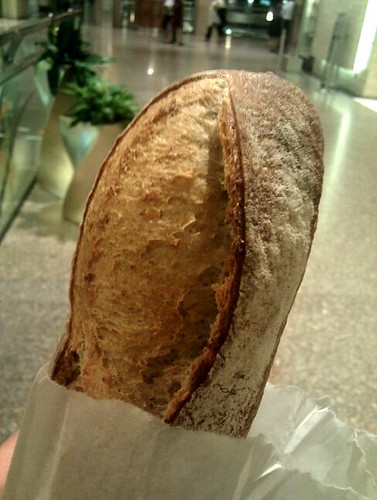
Baguette de chez Robuchon à Hong Kong
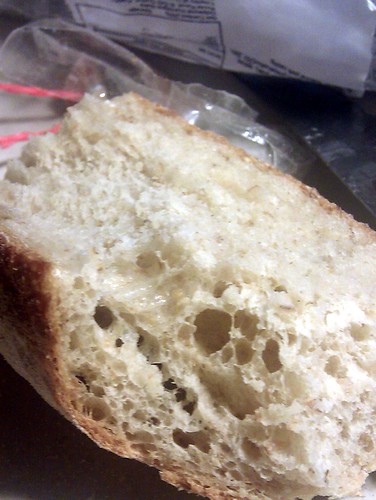
Une baguette dense et moelleuse!
Le pain que j’ai acheté 14$HK était juste suffisant pour me faire un sandwich au saucisson et camembert, et il était certainement le meilleur que j’ai acheté jusqu’à ce jour à Hong Kong (Celui de Première Moisson à Montréal est probablement un peu mieux). La baguette ordinaire était toute vendue, mais habituellement à 20$HK. Celle que j’ai acheté, qu’on m’a dit être de blé entier, aurait en fait pu être un pain au levain, au goût quelque peu acidulé et à la réconfortante odeur de levure.
J’y retournerai et prendrai de meilleures photos.
Donq: excellente et accessible

Donq
En attendant, il y a deux autres boulangeries auxquelles je suis allé dans les derniers mois. L’une d’elles est la boulangerie Donq (voir la première photo). Elle était, avant Robuchon, la meilleure que j’ai mangée à Hong Kong. Le pain était croustillant (plus qu’à Little Mermaid) et se conservait relativement bien la journée suivante.
Comme Little Mermaid, Donq est une boulangerie d’origine japonaise et a deux succursales à Hong Kong. L’une est au sous-sol du grand magasin japonais Sogo à Causeway Bay, tandis que l’autre se trouve à North Point, près de la station de MTR Fortress Hill. Le pain est généralement bon (croustillant et moelleux), et on peut avoir du pain chaud à deux ou trois reprises dans une journée. Il arrive que les baguettes soit trop cuites et prenne une amertume marquée. Pour 17$HK (et plus longue et dense que chez Little Mermaid), c’est moins cher que tous les pains sophistiqués de Hong Kong! À chaque fois que je vais à Causeway Bay, je m’arrête toujours chez Donq pour m’acheter une baguette.
Simplylife: Pour faire changement
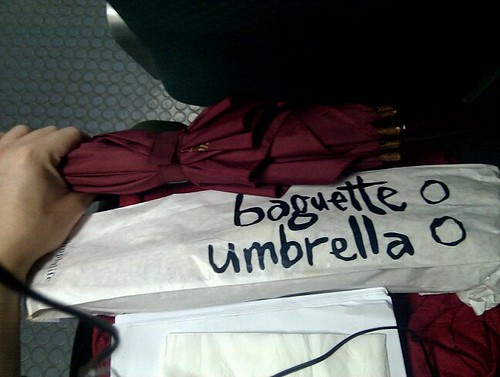
Simplylife
L’autre pain à essayer est chez Simplylife dans IFC Mall. Simplylife est un bistro style occidental et a également un comptoir à pain. La baguette est bonne, mais est plus chère que les autres mentionnées ci-haut, à 22$HK, en plus de n’être pas plus dense que celle de Donq et d’être souvent, sinon toujours, brûlée (à toutes les 4-5 fois que j’y suis allé). Peut-être qu’il y a une logique pour le pain trop cuit, pour une croûte qui reste dûre toute la journée (c’est ouvert jusqu’à ce que le resto ferme, vers minuit on présume), mais ça ne fait pas des baguettes trop appétissantes. Mais c’est aussi une des baguettes qu’on peut aller acheter facilement, car c’est direct dans le IFC Mall, en route vers les quais de Central.
Last week, I was walking on the path behind the famous dessert tofu place in Lamma (where you need to pass to get to the Power Plant Beach), and saw an eggplant field, alongside other vegetable. It turns out that the farmer sometimes go down to Yung Shue Wan’s main street with his load of … Continue reading “Fresh eggplant on Lamma Island”
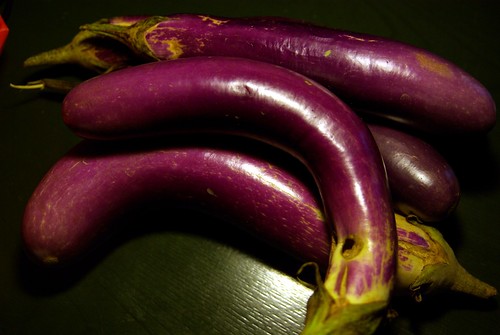
Last week, I was walking on the path behind the famous dessert tofu place in Lamma (where you need to pass to get to the Power Plant Beach), and saw an eggplant field, alongside other vegetable. It turns out that the farmer sometimes go down to Yung Shue Wan’s main street with his load of fresh produce on a metal cart.
We celebrated the actual St-Jean-Baptiste as it should at the dim sum restaurant (Kam Fung on St-Urbain). Frankly, dim sum, “small bits” Chinese brunch, may not always be my favourite meal to have. But in Montreal, it doesn’t get better, as a way to assemble our group of friends around the same table. In fact, … Continue reading “Dim sum with my friends”
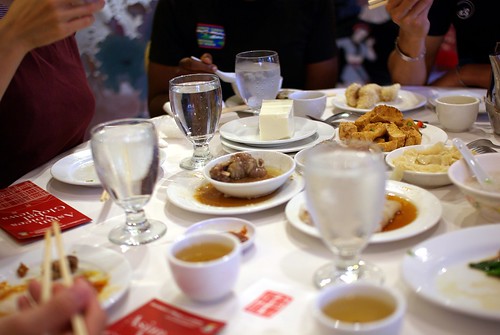
We celebrated the actual St-Jean-Baptiste as it should at the dim sum restaurant (Kam Fung on St-Urbain). Frankly, dim sum, “small bits” Chinese brunch, may not always be my favourite meal to have. But in Montreal, it doesn’t get better, as a way to assemble our group of friends around the same table.
In fact, one good thing about Chinese restaurants is the round tables, instead of rectangular ones that you’d find in Western restaurants. It’s really nice, because I wouldn’t have been able to speak to everyone sitting around the table otherwise.
***
On a célébré la St-Jean-Baptiste comme il se doit, c’est-à-dire au restaurant dim sum (Kam Fung sur St-Urbain). Mais pour être franc, le dim sum est loin d’être mon choix personnel de resto, mais y’a rien qui bât ça quand vient de trouver quelque chose pour rassembler tous mes amis autour d’une table.
Le resto chinois, peut-être comparé au resto occidental, a la qualité de placer les convives autour d’une table ronde, ce qui favorisera les interactions. Si on s’était mis autour de tables rectangulaires, je n’aurais certainement pas pu parler à tout le monde rassemblé ce midi-là. Alors, bravo au concept des tables rondes !
What if you are in a city that you never visited before, and it’s 11pm, in a remote area and you are hungry? We were hanging out near Xinghai Music Conservatory in the northern part of Central Guangzhou, and wandered slightly off to get a really late dinner. We were previously at the Ping Pong, … Continue reading “Dai Pai Dong in Guangzhou, near Xinghai Conservatory of Music”
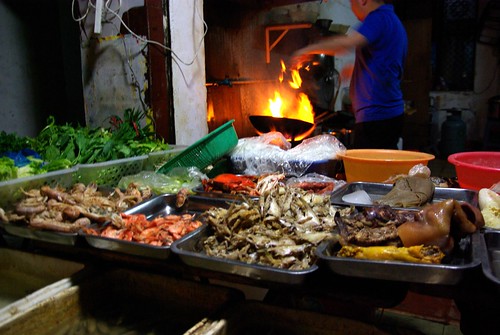
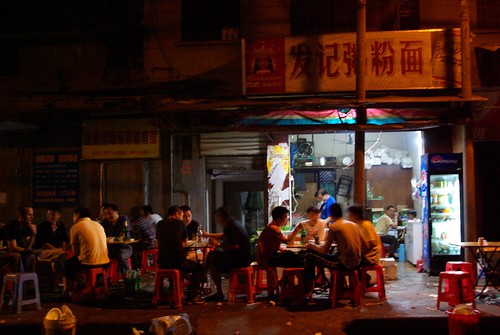
What if you are in a city that you never visited before, and it’s 11pm, in a remote area and you are hungry? We were hanging out near Xinghai Music Conservatory in the northern part of Central Guangzhou, and wandered slightly off to get a really late dinner.
We were previously at the Ping Pong, an arts and music bar right next to campus (opened by a Frenchman, and also serving trademark French/Chinese-style rhums), with occasional performances by some brand names of Chinese independent music. Using the advice from one of the school’s security guards posted nearby, we set off to a nearby street some five minutes away.
As we arrived to it, we picked the one of the two that had more people. Seeing and hearing the foreigners that we were, patrons of the nearby table started chatting us. They were nice and soon helped us order some American beer (while we wanted some local Zhujiang) as well as some food, more importantly.
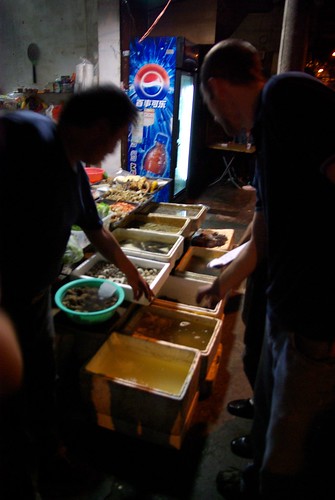

Don’t (necessarily) let yourself be fooled by the looks. Indeed, the hygiene is questionable, and it’s not very clean-looking. They had live shrimp, but our friend Nick picked the dead and cooked ones b/c the former dwelled in too murky waters. Neither of us got sick on the next day, so we can assume that the stir-frying does its sanitizing job.
The shrimp was were in fact some of the best that I ever had, just because they were bite-sized, and have been perfectly fried such that the meat was still tender, and the shells crisp enough to be eaten whole. It was minus the head, most of the times, but I can believe that the fatty heads were perhaps the tastiest part of the poor animals.
Also had a garlic stir-fried veggies platter (choy sum) and “pork” fried with noodles. I wish I was hungrier so to be able to try more. But the shrimp were like the popcorn/chips with the beer (eventually a mix of Zhujiang and Bud in the same glasses that our newly-made friends and the place’s regulars poured for us).
The owner of the place is a quiet man surnamed Liu, who worked the kitchen with his wife.
In all, the three dishes (and lots of beer bottles) set us back about RMB60 for all three of us. Don’t be fooled by this post: there are tons of places like this one. The take-home message is that it’s always a good and safe bet to try a place that has a lot of locals eating at.
Disclaimer: I am not vegan, let alone vegetarian. But my friend Kim, who happens to be vegetarian, was in town a few weeks ago. Often I would take the tramway from Central to Causeway Bay, and notice this shiny, flashy new fast-food restaurant along it in Wan Chai on same block as the gas station. … Continue reading “Loving Hut: Vegan food in Hong Kong”
Disclaimer: I am not vegan, let alone vegetarian. But my friend Kim, who happens to be vegetarian, was in town a few weeks ago. Often I would take the tramway from Central to Causeway Bay, and notice this shiny, flashy new fast-food restaurant along it in Wan Chai on same block as the gas station. The restaurant is called Loving Hut and is in fact a chain originating from Taiwan, but with branches all across the world.
Kim told me that the Chinese-style fake meat she gets in Montreal is often imported from Taiwan. In the Buddhist tradition, followers would have these “vegetarian” days, which I know as “sek zai” (my grand-mother would do these once a week or so, and have tofu-based meals for an entire day).
Just like at a Maxim’s or Cafe de Coral, you must order from a menu next to the cashier. Then, you pick up your receipt and present it to the kitchen counter.
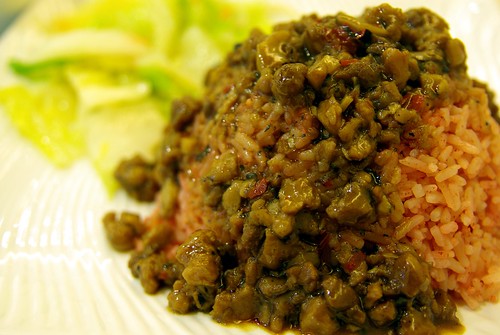
When I went for the first time, I had red rice with mini tofu cubes. Now, I probably ate or saw this dish before in its full-meat version. The vegan version was no less tasty (maybe a bit salty) and I would definitely have it again.

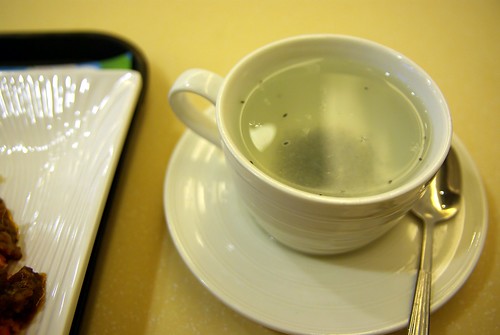
I also had a lemon basil seed (?) drink, which was served warm, and tasted sour with translucent seeds collecting at the bottom of the cup. There were char siu buns too without the char siu.
On a different occasion, now with three other friends, none vegetarians, we tried a larger variety of dishes. One was a classic yu hsiang eggplant, just without the ground pork. And then there was a bunch of noodles and a sweet and sour fried tofu.
===
A days after Loving Hut, we went again for vegetarian food, but this time in a real sit-down restaurant. It’s called Gaia Veggie Shop and is situated in Goldmark, right by the south side of the Sogo intersection in Causeway Bay, in the building next to the empty lot (old Mitsukoshi).
My photos are super low-res, so I am not going to post them. It’s good to know that the goal of this restaurant seems to be to fool you as well as possible. I never had fake sushi fish before, but let me tell you that it practically has the same texture, The menu in fact never specifies that such and such meat is “fake”, and dishes are always simply listed with meat names in it (only that you won’t find any meat in the actual order). Thinking about what we ate already makes me hungry… Aside from the sushi, we had a broth served in a coconut, and beef-wrapped enoki mushrooms. There was perhaps a sweet and sour chicken in there as well.
Pâtisserie La Légende 麗晶餅屋 undergoing renovations Pâtisserie-restaurant Callia (嘉莉/麵包茶餐聽) Side of Pâtisserie Harmonie 麵包蜜語 Whereas the Chinese “food scene” (you can hardly call it a food scene when a city lacks quality Beijing and Shanghai cuisine) in 2009 has been dominated with the arrival of numerous restaurants and eateries opened by Mainland Chinese immigrants in … Continue reading “Bakery renewal or when urban renovation goes through the stomach”
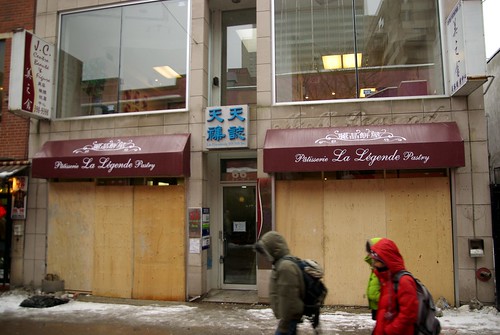
Pâtisserie La Légende 麗晶餅屋 undergoing renovations
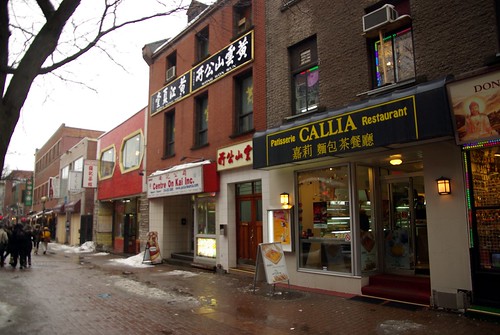
Pâtisserie-restaurant Callia (嘉莉/麵包茶餐聽)
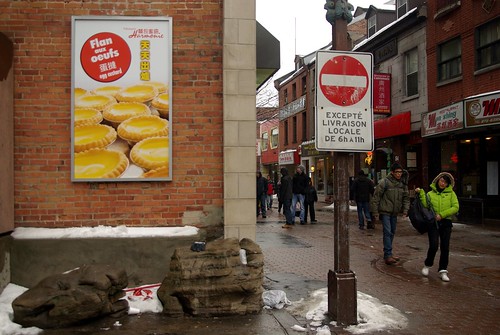
Side of Pâtisserie Harmonie 麵包蜜語
Whereas the Chinese “food scene” (you can hardly call it a food scene when a city lacks quality Beijing and Shanghai cuisine) in 2009 has been dominated with the arrival of numerous restaurants and eateries opened by Mainland Chinese immigrants in Montreal’s new Chinatown, that of the traditional Chinatown on De la Gauchetière (between St-Urbain and Clark) was mostly revamped in the past two years with new Cantonese-owned shops, three of which happen to be bakeries.
Already in the winter of 2008, Harmonie (麵包蜜語) shook Montreal’s Chinese bakery standards by opening at the corner of St-Urbain and De la Gauchetière. Buns left to die on a colourless counter were a thing of the past. Now, Chinese pastries and other bite-size delicacies or cakes would be served in a decor on par with at least what you would see in Hong Kong or other larger Chinatowns of North America: lit-up counters, uniformed staff, floral decorations.
A year later in April 2009, a first competitor Restaurant Callia (嘉莉) was opened (by the family owning Chinese restaurant Keung Kee) across the street. It added the dining space and kitchen that Harmonie did not have, serving Hong Kong’s famed Cha chaan teng-style food of milk tea, beef brisket noodles and Italian noodles in Cantonese sauce, under big TV screens spouting soaps from TVB.
Now on my last visit of Chinatown during the Holidays, I noticed that my grandparents’ favourite (and personal longtime favourite, for lack of anything else) M.M. Légende took over the trendy “Asian-style” clothing store next door and hid behind wooden planks as it is undergoing renovations. For the past two years, I believe that it was to become the first casualty of the Callia/Harmonie combination. So instead, it renamed itself as Pâtisserie La Légende (麗晶餅屋) and decided to expand. Follow-ups would be greatly appreciated!
Maybe now this first casualty would be Dobe & Andy (right under of Kam Fung) if they don’t change. I’m now curious to see what is going to happen with this new huge space for a cha chaan teng, in spite of more restaurant space made available with the imminent inauguration of Plaza Swatow (長盛廣場).
Saturation, or serious signs of Chinese Montrealers moving back to Chinatown? My opinion is that this will largely depend on affordable parking space made available in the area from the Swatow building. Right now, paid parking is prohibitively expensive (no incentive as in downtown Montreal) and free spots can only be found four or five blocks away. A pleasure for nearby residents and public transit users, but a chore for a certain class of car-going suburbanites that I grew up with…
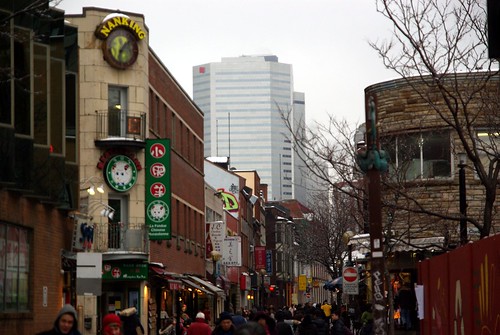
For some reason that evades me, good local Northern Chinese food is a rarity in Hong Kong, where wonton noodles, curried meat soup and Chinese rotisserie dominate the local fast-food landscape. You won’t find roujiamo in a street food stall, while fried tofus, squid, eggplant, or egg tarts, and other pineapple buns are everywhere. (You … Continue reading “A last time raving about Montreal’s Chinese food”
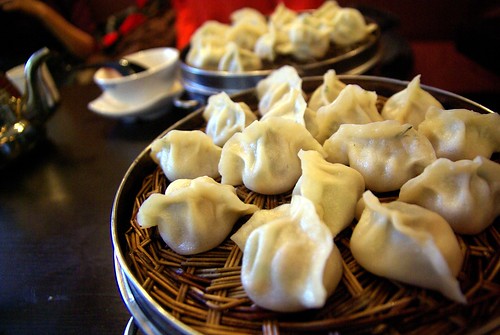
For some reason that evades me, good local Northern Chinese food is a rarity in Hong Kong, where wonton noodles, curried meat soup and Chinese rotisserie dominate the local fast-food landscape. You won’t find roujiamo in a street food stall, while fried tofus, squid, eggplant, or egg tarts, and other pineapple buns are everywhere. (You might also easily find upscale-ish Shanghai or Beijing restaurants in Hong Kong.)
So I made sure that as a must-have meal in Montreal, as I’m spending the Holidays here, among smoked meat and bagels (although no time for poutine), I would eat dumplings, Northern-style. One of Montreal’s prime locations for dumplings is Qing Hua Yuan. They were on St-Marc when they opened last year, but reopened this Fall on Lincoln, close to St-Mathieu in our Chinatown Two, near Concordia University.
The boiled dumplings are nothing special, but now the steamed ones! In contrast to their boiled counterparts, they perfectly conserve their full taste, and if you are a connoisseur of food, you would be careful to pierce your dumpling, savour the broth inside, before engulfing the rest of the jiaozi. The flavours seem to have expanded by a bit (any combo of pork, lamb, chicken, eggs, vegetable, anise, coriander, Chinese cabbage, etc.), on top of the surprising fried dumplings. Extra goodness: the taste of the reed coming from the steamer.
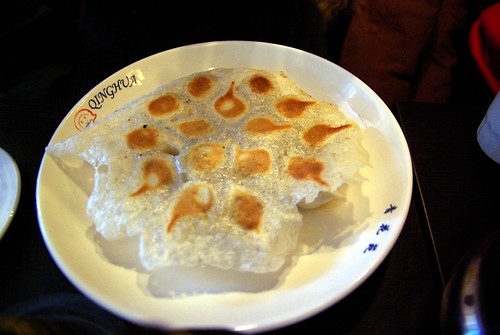
The fried ones (see second picture of this post) are served with a fine film, which I am guessing comes from a dried-up flour mixture, which in itself puts up a nice show.
Unfortunately, they only staffed one person to take care of the whole floor at lunchtime (it was the Holidays though), and cooled-off dumplings and unusually slow service (one hour from sitting to getting meal at lunchtime) were the resulting minus points. On the other hand, they thought of giving shrimp chips as a free-of-charge snack now, like they would give bread in a European restaurant, because steamed dumplings usually take 25 to prepare.
But is not cheap. On my second time there, with my parents at dinnertime, we needed four portions to be full (depending of flavour, steamer/plate is $8-13, + taxes/service). But hey, you’re paying for hand-made top-quality dumplings.
Qing Hua Dumpling, (438) 288-5366, 1676 Ave Lincoln, Montreal, QC H3H
Not too far of a walk from Wan Chai MTR station on Hong Kong island, you will find the Islamic Centre Canteen on the 5th floor of a muslim religious centre. People come to the Masjid Ammar and Osman Ramju Sadick Islamic Centre to pray, but also to enjoy good halal Chinese food. How can … Continue reading “Halal dim sum in Hong Kong”
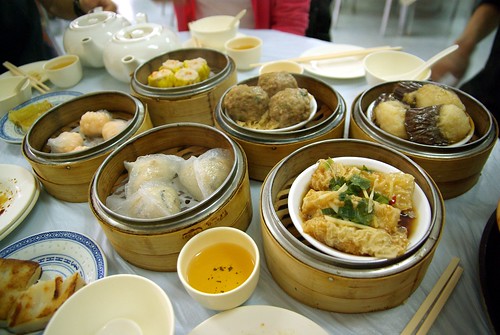
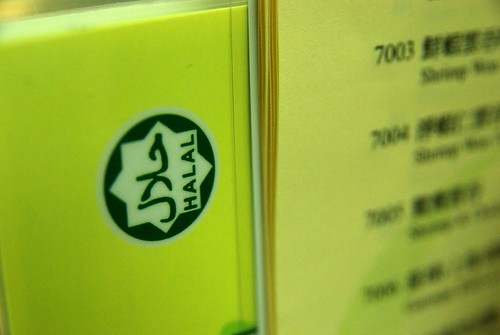
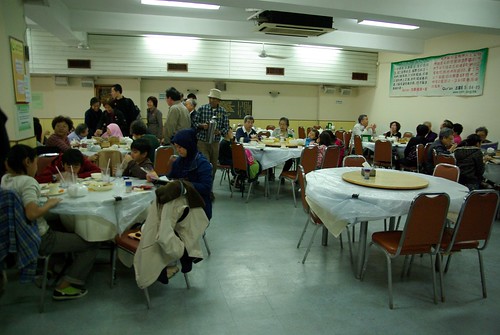
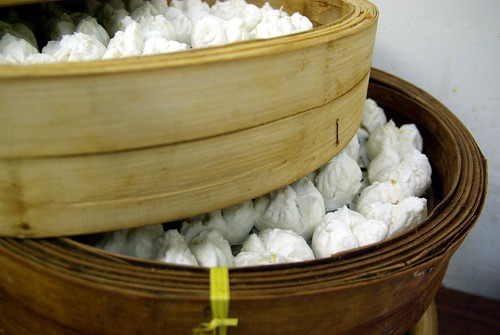
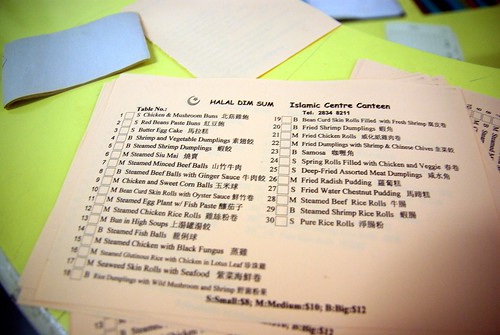
Not too far of a walk from Wan Chai MTR station on Hong Kong island, you will find the Islamic Centre Canteen on the 5th floor of a muslim religious centre. People come to the Masjid Ammar and Osman Ramju Sadick Islamic Centre to pray, but also to enjoy good halal Chinese food. How can you have dim sum without pork, one might ask.
We ordered a generous variety of dim sum classics such as har gow, siu mai (w/o pork, eh), cheong faan and lo mai gai, and were able to get out of there for HKD30 (CAD4) each. Normal: the “big” (most expensive) dim sum were priced at only HKD12. I must say that it wasn’t the best dim sum I ever had in Hong Kong, but it was decent enough. It is featured in the Hong Kong tourist guide for people of muslim faith, and we noticed a number of people from Southeast Asia.
Islamic Centre Canteen. 5/F, 40 Oi Kwan Road. Wan Chai, Hong Kong, 2834 8211. Business Hours: 9:00a.m.10:00p.m.
Eating local in Hong Kong is a rather hard thing to do. The most local food usually gets are fruits and vegetable from over the border in China’s Guangdong province. However, if you are living in the “countryside”, like on Lamma Island, chances are that you might be finding a small farm next to where … Continue reading “Fresh fresh veggies on Lamma Island”
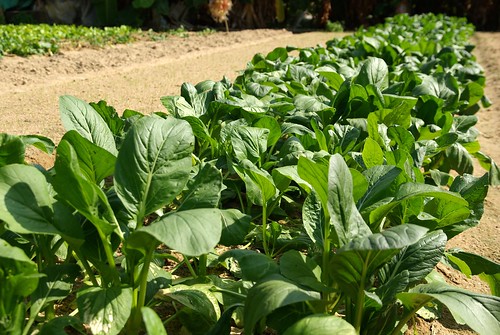
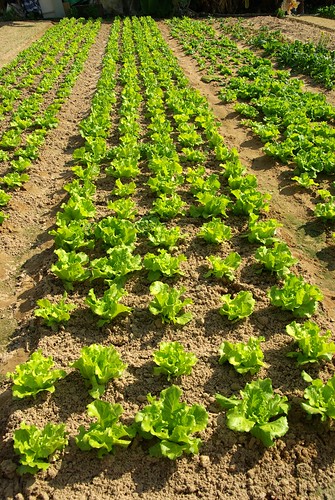
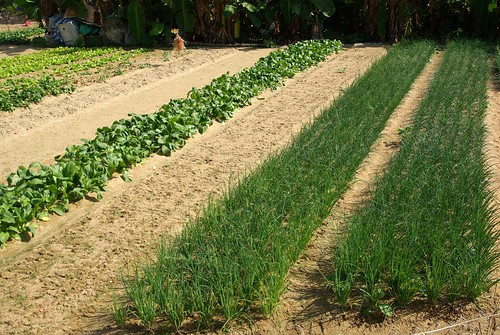
Eating local in Hong Kong is a rather hard thing to do. The most local food usually gets are fruits and vegetable from over the border in China’s Guangdong province.
However, if you are living in the “countryside”, like on Lamma Island, chances are that you might be finding a small farm next to where you are living. This is what I discovered when my friend who has been living on Lamma for some time took me to this small chunk of land, in the small valley at the entrance of Tai Peng village, cultivated by an man maybe in his 60s. With his peasant hat, tool in hand, he seems to be straight out of some old movie, growing his vegetables on this island that is better known for its seafood, great outdoors and hippie culture.
(Next to their field, they are going to be developing new houses… so who knows if the farm’s going to last.)
For one HKD (13 Canadian cents), you can get about three branches of choy sum (菜心), with gigantic leaves. For the same price, you can also get more than enough of green onions (蔥), for what would cost 2-3 times more in Lamma’s grocery stores, and 4-5 times more in my hometown in Canada.
The next day, I came back for some yeen choy (莧菜), a kind of Chinese spinach with red pigmentation on its leaves also called Amaranth, a lad tougher than the regular kind of spinach. A portion for that evening’s dinner cost me two HKD (about 25 Canadian cents). They were delicious, fried with garlic and salt.
The lettuce, the man said, were going to be plump enough at the end of November…
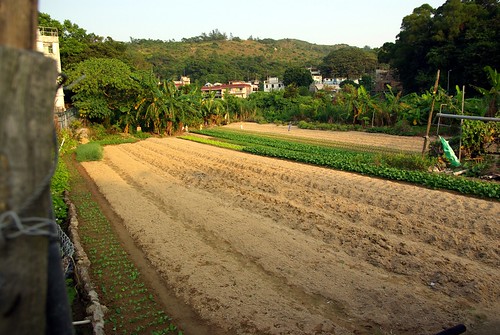
A view of the field as dinnertime approaches…
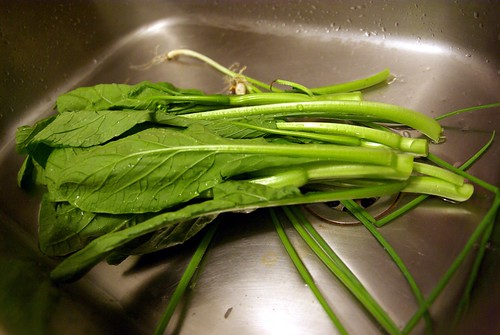
…and my sink at dinnertime
Edit (2010-01-02):