Archive for the ‘Quartier Chinois / Chinatown’ Category

Callia: a new Hong Kong-style bakery-restaurant sets shop in Chinatown

Monday, April 20th, 2009

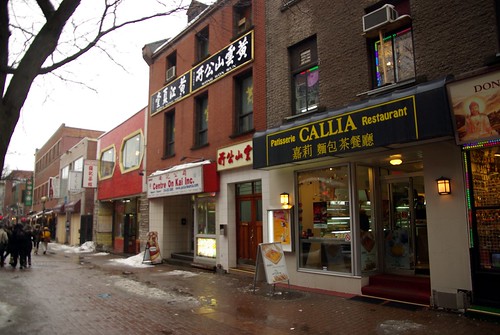
Pâtisserie-restaurant Callia 嘉莉 麵包茶餐聽

Pâtisserie-restaurant Callia 嘉莉 麵包茶餐聽 (intérieur)

Pâtisserie-restaurant Callia (嘉莉/麵包茶餐聽) just opened over the weekend in Montreal’s Chinatown and I went to check it out.
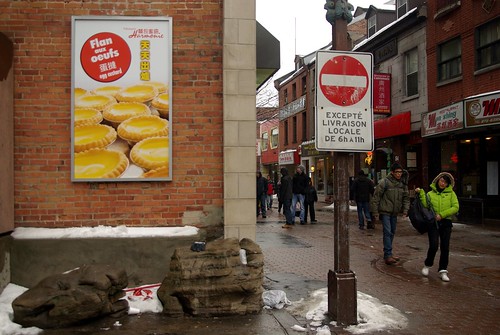
I was initially surprised at how fast it appeared – I didn’t even notice that the former tenant, a Chinese restaurant presumably branded as upscale, had closed shop. The owners, I think, are from Hong Kong, based on the use of traditional Chinese characters. It is a Hong Kong-style bakery-restaurant and its restaurant part is better known as cha chaan teng (literally tea salon – but better known for that sub-genre of European-Chinese fusion cuisine evolved from the colonial era in Hong Kong.

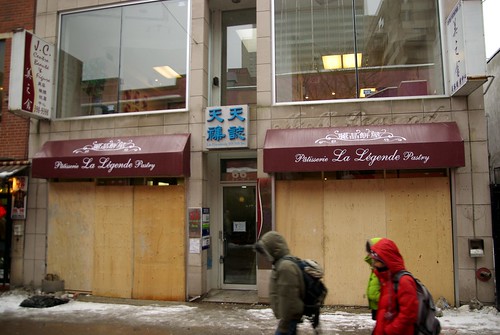
Callia’s formula is the same as long-time incumbent MM Legende (Lai Tsing), which has been around for at least a good decade. The same stretch of De la Gauchetière between Clark and St-Urbain now has four different shops selling drinks and pastries. Is it going to be one too many?

Another cha chaan teng called Pêches used to exist across from MM Legende (downstairs from Bubble Tea L2 – where “My Cup Of Tea” used to be) but won the war of the cha chaan teng. Montreal Chinatown hardly sounds like a battlefield for this kind of business, but with Harmonie at the corner of St-Urbain, it seems this time unlikely that MM Legende could be able to compete solely based on looks – it is my grandparents’ one and only hangout place when they are in Chinatown.

Pâtisserie Harmonie
A customer browsing Chinese pastries at Harmonie in Chinatown

May - MM Legende
MM Legende, bottom-right corner

However, we have yet to actually try things out at Callia. It was incredibly packed today as the staff (interestingly wearing suit uniforms) was selling stuff at a big discount for the grand opening. The dining room was a big mess. We’ll give their Hong Kong milk tea and whatever macaroni-in-its-broth a try before giving any non-aesthetic appreciation of the place!

Edit (2009-05-03): Apparently, this place was opened by the people of Keung Kee, a few doors down. I actually ate at Callia tonight and it was pretty good. My dad got a brisket noodles, while my mom had a Yu Hsiang Eggplant (with bits of delicious dried fish). I had a Brisket Rice with a cream soup with corn (not corn cream) and of course a standardly good Hong Kong milk tea.

Yu Hsiang Eggplant

Beef Brisket Rice

Montreal’s other Chinatown in 2009

Monday, April 13th, 2009

Qing Hua Yuan 青花苑 (Green Courtyard) - 1240 Rue St-Marc

Thé Tapioca, Sichuan cuisine 川菜

Grillades Bizou - 2065A Rue Bishop

Chinesified patch of houses

Ste-Catherine & Pierce, Montréal

I took advantage of Good Friday to go out with my camera to take pictures in the neighbourhood west of Concordia University. A new Chinatown has been thriving there for at least fifteen years. It was my personal experience as a consumer of Chinese food that usually led me to this area. It goes back to 1993 when Soupe et Nouilles’ (Ste-Cath & St-Marc) concept of a soup and noodles fast-food restaurant with its kitchen in front was still novel to many Montrealers.

What used to be confined to North Americanized versions of Cantonese and Szechuanese (Sichuanese) regional genres is now evolving along the growing student and immigrant population from Mainland China. We now see an influx of new quick food restaurants that you commonly find in China, like brochette (chuan – 串) and homemade noodles, dumplings houses.

The pork sandwich, two loaves of flat crunchy bread with a mix of braised fatty pork and coriander (see picture), can notably be found at a cafeteria-like resto on St-Mathieu north of the Metro exit. Homemade noodles and dumplings (topic of a photo-article to be published) can also be found in the neighbourhood as a dumplings house opened on a residential stretch of St-Marc close to the Canadian Centre for Architecture.

General Tao Chicken and Orange Beef, ubiquitous in any Chinese restaurant ten years ago, are nowhere to be found in these of Chinatown West’s newest components.

Chinese restaurants, but also hair salons, “Asian-style” clothing stores now live side by side with Middle Eastern épiceries, takeouts and shisha joints. Whereas Chinatown is evolving in a very dramatic way with the building of a shiny new shopping and business centre, I find that Montreal’s other Chinatown has perhaps changed in a more gradual and low profile manner. And I’m sure it will continue to surprise me, at least food-wise.


View

Montreal’s new Chinatown in a larger map

This article also appeared on Spacing Montreal.

Le Swatow Nouveau fait son nid

Sunday, March 8th, 2009

Plaza Swatow - March 2009
La Plaza Swatow sur St-Laurent

Plaza Swatow - Clark side - March 2009
La Plaza Swatow sur Clark

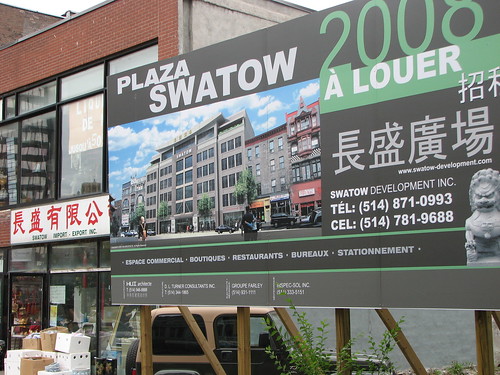
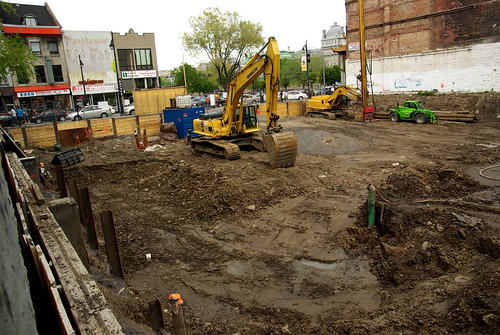
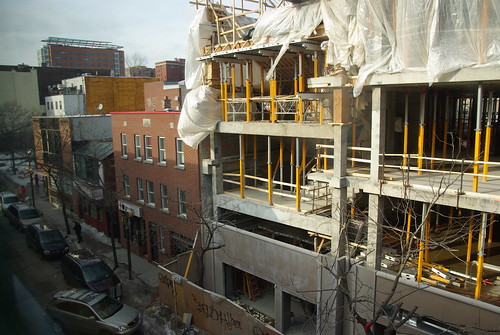
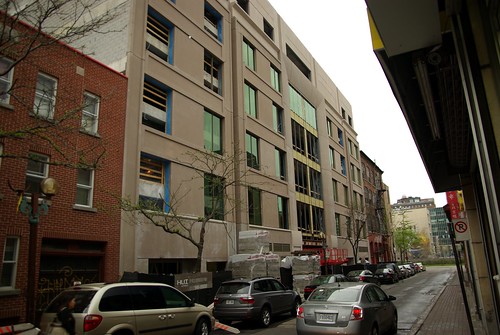
La Plaza Swatow(長盛廣場), un ambitieux projet de 20 millions de dollars, prend forme lentement au coeur du Quartier Chinois de Montréal.

Donnant à la fois sur Clark et St-Laurent, l’immeuble s’élévera sur six étages et comprendra de l’espace commercial pour de petites boutiques et probablement un ou des restaurants.

De mémoire, cet emplacement avait toujours été un terrain vague, pratique pour passer de Clark à St-Laurent après avoir fini de bouffer au Ruby Rouge. Dans quelques mois, on pourra à nouveau y passer, mais ça sera plutôt à travers banques, épiceries ou autres petites boutiques.

The new and the old Swatow
L’ancien et le nouveau Swatow, septembre 2007

Swatow Plaza - May 2008
La Plaza Swatow en mai 2008

Ça avait fait bien du sens en mai 2008, lorsqu’on a commencé à creuser le terrain sous la Plaza Swatow. Avec la crise économique mondiale qui frappa, je me suis bien demandé si la construction du bâtiment allait s’arrêter en plein milieu. En fait, si je me fie à cette photo datant de 1983 prise par mon père, la dernière construction d’importance au Quartier Chinois coïncidait aussi avec une autre crise économique (et les promoteurs espèrent aussi que ça ouvrira à temps pour la reprise).

Depuis que je vis en ville, le Quartier Chinois est un lieu où je retourne pas mal plus souvent. J’y ai rencontré de nouveaux amis, découvert de nouvelles façons de cuisiner. Alors, qu’on y construit un grand complexe, je ne peux y voir que du bien. Six étages, c’est beaucoup d’espace, mais je pense que la population chinoise grandissante à Montréal le justifie bien. On se croise les doigts pour qu’ils ouvrent des restaurants et cafés avec la même variété qu’on trouve à Toronto ou Vancouver!

Plaza Swatow - Seen from Ruby Rouge - March 2009

Plaza Swatow - March 2009

Plaza Swatow - March 2009

Une re-publication de cet article sur le blogue Spacing Montréal a attiré bien de la discussion !

[Cultural note 2009-03-20: The Chinese name of the project is 長盛廣場, or "Changsheng Guangchang" in Mandarin and "Coengsing Gongcoeng" in Cantonese (jyutping romanization), literally "everlasting blossoming". This is not what the name in English characters "Swatow" means - in fact, Swatow refers to the city of Shantou, as Kate McDonnell points out correctly on her blog. Why the discrepancy? I don't know, but it surely is because Swatow Import Export Inc. was named in Chinese as well...]

A historical tour of Montreal Chinatown

Monday, December 22nd, 2008

Chinatown Historical Tour - Summer 2008
Palais des congrès esplanade

A friend of mine, Trevor Fraser, organised a historical tour of Chinatown last summer for a few of us. Starting at where the Palais des congrès plaza currently is, he explained that the Catholic Centre on Viger was built after the city signified that they were going to destroy the church on De la Gauchetière and Jeanne-Mance. Of course, the church is still where it should be, as the city reversed its decision, but the Centre was built anyways and still used today.

Chinatown Historical Tour - Summer 2008

On our way there, we stopped by a strip of buildings facing the infamous Guy-Favreau building, which was constructed at the cost of a block of Montreal Chinatown (as seen on Radio-Canada’s digital archives website).

Back on De la Gauchetière, we noticed the names of the people/families that built the houses, on panels holding on top of the buildings.

Trevor Fraser
Trevor Fraser

Here are notes (Google Docs format) that Trevor provided us with.

Maman, c’est fini! (the 2008 Olympiads, that is)

Monday, August 25th, 2008

Beijing 2008 Olympics @ Montréal Chinatown

It’s hard to believe that the Olympics are now finished! “F-I-NI, fini”, as you would say in the local idioms. This was a picture taken this Saturday of the outdoor presentation of the Radio-Canada’s coverage of the Beijing Games, from 9 to 9, in Parc Sun Yat-sen at the heart of Montreal’s Chinatown. It was a remarkable use of this public space, as people of all ages gathered to watch.

Beijing 2008 Olympics @ Montréal Chinatown

Beijing Olympics opening ceremony in Montreal Chinatown

Friday, August 8th, 2008

Beijing Olympics @ Montréal Chinatown

This morning, I woke up much earlier than usual to watch the opening ceremony to the 2008 Olympic Games in Chinatown.

On montrait les Jeux Olympiques au travail sur écran géant, mais par hasard, j’ai entendu à la radio qu’on les montrait aussi sur écran géant au Quartier chinois…

>> Voir toutes les photos / See all photos

Beijing Olympics @ Montréal Chinatown

Beijing Olympics @ Montréal Chinatown

Beijing Olympics @ Montréal Chinatown

Beijing Olympics @ Montréal Chinatown

Beijing Olympics @ Montréal Chinatown

Beijing Olympics @ Montréal Chinatown

Beijing Olympics @ Montréal Chinatown

Chinatown, la nuit

Saturday, July 5th, 2008

Fermé

A Lam Kee / Hui Tack Wing

My cup of tea

Poon Kai Restaurant

May

After the tribute to Leonard Cohen at Place des Arts last week, I biked down in the opposite direction to home, and snapped some pictures of Chinatown after midnight.

Après l’hommage à Leonard Cohen à la Place des Arts la semaine dernière, j’ai pédalé dans la direction opposée de chez moi, et ai pris quelques photos du Quartier Chinois après minuit.

Marche et vigile en mémoire du séisme du Sichuan ce samedi

Friday, June 6th, 2008

En souvenir du 12 mai / 纪念5.12

Toute la journée, ce samedi 7 juin, auront lieu au Quartier Chinois de Montréal des activités spéciales à la mémoire des victimes du séisme qui secoua la province chinoise du Sichuan, le mois dernier. Le groupe de marcheurs quittera le Parc Sun Yat-sen peu avant 16h, pour se diriger sur le Boulevard René-Lévesque, jusqu’à la Rue McGill, en revenant par le Vieux-Montréal vers le Quartier Chinois. Une commémoration se déroulera ensuite en soirée, de 19h à 21h au Parc Sun Yat-sen.

Communiqué de presse (Français / Anglais)

***

This Saturday, June 7th, for the entire day, special activities will be held in Chinatown in memory of the victims of the earthquake that shook the Chinese province of Sichuan. The walk will start in Sun Yat-sen park shortly before 4PM, and will march on Boulevard René-Lévesque, up to McGill Street, and then head back to Chinatown through Old Montreal. A commemoration will then happen in the evening from 7PM to 9PM at Sun Yat-sen Park.

Press release (French / English)

Sichuan earthquake in Montreal

Saturday, May 24th, 2008

Dons
Magasin d’art, Parc Sun Yat-sen / Art shop, Sun Yat-sen park.

Je me suis promené cet après-midi au Quartier Chinois à la recherche de signes de compassion à l’égard des victimes du séisme du 12 mai au Sichuan.

I walked in Chinatown this afternoon, looking for signs of compassion for the victims of the May 12th Sichuan earthquake.

Lisez la suite de cet article / Read the rest of this entry »

L’épicerie chinoise qui hurla ses bas prix, le volume dans le tapis

Sunday, March 16th, 2008

Wing Cheong Hong - Quartier Chinois de Montréal

Vieilles tactiques de vente, nouveaux moyens technologiques. Il y a deux semaines, un dimanche en fin d’après-midi, je me promenais dans le Quartier Chinois de Montréal pour faire mes courses comme à l’habitude. Alors sur De la Gauchetière, rendu à Clark, une voix forte et animée (et amplifiée), venant d’environ une trentaine de mètres en bas cette dernière, me réveilla de ma paisible marche. Franchement! D’où est-ce que ça pouvait bien venir?

Ça venait du haut-parleur de l’épicerie Wing Cheong Hong, et les annonces étaient celles des bas prix du jour que lançait tel un encanteur le président de l’entreprise, M. Bobby Chen, alors au contrôle du micro à cette heure-là. À ce que je sache, aucune autre épicerie chinoise au Quartier Chinois ne compte sur ce stratagème.

J’entre dans le commerce, et après avoir ramassé mon paquet de bok choy pour la semaine, je pique une jasette avec M. Chen. Il me dit que le fait de hurler les spéciaux du jour à la porte du commerce est une pratique courante au Japon. « Ils n’ont pas le droit d’utiliser de micros là-bas, alors pour vendre le stock qu’il viennent de recevoir en spécial, ils embauchent des gars avec des porte-voix, puis des belles filles en bikini! », me dit-il.

Il va sans dire que les marchés d’alimentation, depuis l’aube de l’Humanité, ont usé de ce procédé pour vendre leurs salades. Je n’ai pas demandé à M. Chen s’il avait effectivement le droit d’en faire de même avec les moyens de nos jours. En tout cas, si la musique forte est acceptable, alors pourquoi pas une circulaire parlante?

Bobby Chen
M. Chen, aux commandes.

An English version of this article was published on Spacing Montreal.

Chinatown’s Jewish History

Monday, January 28th, 2008

Jewish Chinatown

Today, my friend Chris DeWolf wrote an article in the Gazette about Montreal Chinatown’s Jewish past:

If Chinatown’s Jewish heritage isn’t obvious, it’s probably because it has been erased by time and redevelopment, swept away like Chenneville St. and its quietly imposing synagogue.

(…)

Located on a small street (now shortened and written as Cheneville) between St. Urbain and Jeanne Mance Sts., below Dorchester (now René Lévesque) Blvd. and above Craig (now St. Antoine) St., it was built in 1838 by Montreal’s oldest Jewish congregation, Shearith Israel.

In 1887, when Shearith Israel moved to a much larger home on Stanley St. – following the westward migration of Montreal’s older generations of Canadian-born, anglicized Jews – the synagogue was rented by Beth David, a congregation of Romanian immigrants who arrived in the late 19th century, part of a huge wave of Jewish immigrants from eastern Europe. Over the next three decades, the area around present-day Chinatown – with Bleury St. to the west, Sanguinet St. to the east, Craig to the south and Ontario St. to the north – became the heart of Jewish Montreal, a haven for Yiddish-speaking immigrants who established businesses, synagogues and many of the Jewish institutions that still exist.

Israel Medresh, a journalist for the Kanader Adler, a Yiddish-language daily newspaper, sketched a portrait of the neighbourhood in his 1947 book Montreal Foun Nekhtn, translated into English in 2000 as Montreal of Yesterday.

“The corner of St. Urbain and Dorchester was the very heart of the Jewish neighbourhood,” he wrote. “Nearby was Dufferin Park, then a ‘Jewish park’ where Jewish immigrants went to breathe the fresh air, meet their landslayt (compatriots), hear the latest news, look for work and read the newspapers.”

Just a few blocks from Dufferin Park stood seven synagogues, the first Young Men’s Hebrew Association and a number of important community and political organizations like the Baron de Hirsch Institute, the Hebrew Benevolent Society and the Jewish Labour Temple.

Cinéma Sun Ko Wah 新國華

Wednesday, January 16th, 2008

Sun Ko Wah : La Librairie Chinoise

It was through a quick search to see whether the Sun Ko Wah (新國華) boutique and bookstore on this picture still existed (it probably does), that I realized that Chinatown’s now-defunct cinema on St-Laurent Boulevard (near René-Lévesque) was also called the Sun Ko Wah! Yes, according to infos on the web, this cinema existed between 1989 and 1995. My memories seem to point to a much earlier period, but the end of it may indeed be 1995, year of the exodus for many Montreal Chinese of previous immigration waves.

In any case, I was still too young in 1995 to go to a movie theatre (and remember really wanting to go to it, despite my young age), and never ventured inside this manifestation of the micro and ethnic cinema in Montreal. When I got old enough to go see a movie by myself, the Sun Ko Wah Cinema became a jewelry shop. Was left behind, a different business at around the same civic number on Clark Street, bearing the exact same name.

Association cantonaise de divertissement pour l’âge d’or

Tuesday, January 15th, 2008

LO Ha - Association cantonaise de divertissement pour l'âge d'or
LO Ha, de l’Association cantonaise de divertissement pour l’âge d’or

Samedi dernier, je me suis promené au Quartier Chinois avec mes grands-parents, c’est-à-dire les parents à ma mère. Ça fait plus d’une vingtaine d’années qu’ils se sont installés à Montréal, et le Quartier Chinois est pour eux l’endroit où ils retournent et peuvent évoluer dans leur langue, le Cantonais. Pourtant l’un des deux dialectes les plus parlés par les chinois ayant immigré outre-mer avant l’ouverture de la Chine continentale, le Cantonais n’est cependant parlé que par 80 millions des 1,4 milliards de Chinois. Mais au Quartier Chinois de Montréal, comme c’est le cas de plusieurs quartiers chinois à travers le monde, le Cantonais est encore une langue dominante dans la plupart des commerces.

Avec eux, nous avons fait le tour des pharmacies (occidentale, cette semaine), épiceries et cafés, en s’arrêtant au milieu par un lieu tout à fait invisible de la rue, l’Association cantonaise de divertissement pour l’âge d’or. L’Association se trouve située sur De La Gauchetière, à quelques numéros à l’Est de St-Urbain, au sous-sol d’un édifice à l’entrée mal éclairée.

Comme son nom l’indique, l’Association est un club de l’âge d’or. La porte de vitre y menant, avec les heures d’ouverture de l’endroit, dessus accrochées, aurait pu être celle d’un restaurant ou d’un vieux commerce de brocante, mais au bas des escaliers se cache un surprenant temple chinois. Mon grand-père me dit au passage que les touristes en visite au Quartier Chinois s’arrêtent régulièrement à l’Association, qui ressemble plus à un temple qu’à un club social.

« Ça fait depuis 1980 que je suis au Canada », me raconte Lo Ha, l’homme d’une soixante-dizaine qui semble être le gérant de l’endroit, après quoi il échange avec mes grand-parents et autres gens présents cet après-midi. On va d’un cantonais brisé (le mien) à un français tout autant brisé (plutôt le sien) tout au long de notre conversation.

L’accent de M. Lo, en chinois, aux tons nasillards m’avait d’abord porté à croire qu’il était un Chinois ethnique du Vietnam. Il était en fait originaire du Laos, pays sans littoral de l’Asie du Sud-Est. En 1980, cinq ans après avoir vécu dans un camp de réfugiés en Thaïlande, il immigra à Montréal avec ses 11 enfants et au total 32 membres de sa famille. Il m’a ensuite écrit le nom de leur ville d’origine au Laos, 他曲 (Ta Qu en Hanyu Pinyin, Thakhek en Laotien) dans la province du 甘蒙 (Khammuan). Une recherche sur Google est de mise.

Les ancêtres de M. Lo viennent de 三水 (San Shui) dans le Guangdong qui fait maintenant partie de la super-agglomération de 佛山 (Foshan, ou Futsan en cantonais), dans les environs de la capitale provinciale de 廣州 Guangzhou (Canton), et là d’où viennent également mes grand-parents.

Guan Yu 關羽
Une statue en marbre blanc de Guan Yu (關羽)

Trois statues en marbre blanc, représentant Guan Yu (le héros des Trois Royaumes), Tian Hou (aussi appelée Tin Hau, que je connais à cause de la station de métro et du lieu de culte duquel elle a été baptisée, à Hong Kong), et une déité que je ne connaissais pas, prennent place sur une table où se bousculent plantes vertes, jarres d’encens et collations chinoises en offrande. Dans une salle à l’arrière du local, immanquablement, des hommes âgés passent le temps autour d’un jeu de dames chinoises.

110B Rue de la Gauchetière O. 514-878-1551