Archive for the ‘Hong Kong’ Category

Une idole du Cantopop se produit à Montréal / Cantopop idol Jason Chan 陳柏宇 in Montreal

Saturday, October 25th, 2008

Jason Chan 陳柏宇 in Montreal

Le concours de chanson amateur « Rogers Famous 2008 » aura comme invité de marque une vedette du Cantopop de Hong Kong, Jason Chan 陳柏宇. Chan est relativement un nouveau venu de la scène musicale pop cantonaise, mais a déjà à son actif trois albums. Il a vécu à Toronto une bonne partie de sa vie, et cite My Chemical Romance et Linkin Park comme musique anglophone qu’il écoutait (mais sa musique sont plutôt des balades douces pour adolescentes).

Il s’agit d’une deuxième année de suite que les organisateurs de Famous, RVision Productions (j’ai monté leur site), invitent des stars de Hong Kong pour occuper une partie du billet. Le duo féminin « indie » at17 étaient alors les invitées en octobre 2007. Nos derniers souvenirs d’une star du Cantopop à Montréal remontaient alors à une certaine performance par Jacky Cheung au milieu des années 90…

Le spectacle (et finale de la compétition de chant) aura lieu au Club Soda, ce dimanche 26 octobre. Les billets seront disponibles à la porte pour $45. (Ça sera entièrement en cantonais, mais c’est certainement intéressant pour l’expérience culturelle, on se dit.)

(Plus de photos de la conférence de presse ce vendredi soir)

***

Cantopop idol Jason Chan 陳柏宇 is the guest artist at Rogers Famous 2008 Chinese singing contest in Montreal. Chan is relatively new to the Cantonese-language pop scene in Hong Kong, but has already released three albums. Having lived in Toronto for a long period of his life, he cites My Chemical Romance and Linkin Park as English-language music he listens to (his music tends to be aimed at teenage girls).

This is the second year in a row that the event promoters, RVision Productions, are inviting Hong Kong stars to occupy part of the evening’s bill. In October 2007, feminine duo at17 were the event’s guests. Our memories of Cantopop stars performing in Montreal date back to Jacky Cheung in the middle of the 90s…

The show (and singing contest finale) will be held at Club Soda this Sunday October 26th. Tickets will be on sale for $45 at the door.

(More photos of the press conference this Friday evening)

Le parc Belmont et la mort du parc d’attractions ailleurs dans le monde

Sunday, September 14th, 2008

Adieu parc Belmont!
(Archives de Radio-Canada, diffusion originale: 1963-09-06)

Le site des Archives de Radio-Canada recèle de nombreux petits trésors, dont ce clip vidéo sans narration de sept minutes, datant de 1963 et qui traite du parc Belmont. Le célèbre parc d’attractions était situé à Cartierville au nord-ouest de Montréal et ferma définitivement ses portes en 1983, après 60 années d’existence.

Les problèmes du parc Belmont débutent dès la création de La Ronde, lors de l’exposition universelle de 1967. Malgré une année record, en 1972, de 750 000 entrées, le nombre de visiteurs diminue progressivement. Même l’arrivée de nouveaux manèges ne suffit plus à maintenir l’achalandage. En 1979, l’accident du manège « paratrooper » blesse deux enfants et ruine l’image de l’institution. Elle vieillit mal. L’été avant sa fermeture, le parc Belmont n’obtient que 316 000 entrées.

Avec les plaintes d’un voisinage résidentiel, une descente de police, qui nuit à sa réputation, et une hausse des taxes, le parc Belmont est condamné à fermer ses portes le 13 octobre 1983.

Je n’ai aucune mémoire du parc Belmont, étant né que quelques années avant sa fermeture finale. Des lieux comme le Belmont exercent une certaine fascination chez moi, peut-être parce qu’ils témoignent d’une époque révolue, celle de l’amusement par des moyens technologiques qui ont peut-être fait leur temps, comme la maison hantée et les montagnes russes, maintenant remplacées par un bon jeu vidéo à la Half-Life, ou le dernier Indiana Jones.

Old Amusement Park / Kaiping 开平 / Changsha Park 长沙公园

Ailleurs dans le monde, on peut aussi à l’occasion rencontrer des parcs d’amusements abandonnés sur son chemin. Cette photo fût prise au début du mois de mai, et provient du parc Changsha (长沙公园) dans la ville de Kaiping, province du Guangdong, dans le sud de la Chine. Le Changsha est un parc boisé de la taille de notre Carré St-Louis, en plein centre-ville (deux blocs à l’est du terminal de bus inter-cité), et qui a maintenant l’air de servir de parc public.

Parmi les manèges abandonnés (ça m’étonnerait qu’on les époussète juste à chaque année l’été venu) – un carrousel, des navettes rotatives, et une arène d’autos tamponneuses, sans autos tamponneuses – se trouvait aussi un centre d’activités municipal dont on se servait encore, vu les jeunes qui en sortaient, alors que nous passions dans le parc.

群展香港观记-王禾璧

Lors d’un voyage précédent en Asie, au printemps 2005, cette fois-ci à Hong Kong, j’avais été à une exposition photographique intitulée « Hong Kong Four-Cast » au Musée de l’Université de Hong Kong et dont un recueil fût publié à la suite.

Les pièces les plus marquantes pour moi furent celles du défunt Lai Chi Kok Amusement Park, ou Lai Yuen (荔園) pour les intimes. La photographe hongkongaise Wong Wo-bik avait alors pris des clichés du parc d’attractions et zoo à la veille de sa destruction en 1997, alors qu’il était déjà abandonné depuis quelques mois.

Lai Yuen était encore au début des années 80 le château des illusions et de l’épouvante où des milliers d’enfants et d’adultes se pressaient. Wong Wo Bik a ainsi recueilli ces vestiges et a par juxtaposition ou autres procédés recréé ces images : Des lieux éphémères plein d’imagerie populaire qui ont compté dans la vie des Hongkongais et ont disparu sans laisser aucune trace. C’est un passé recréé pourrait-on arguer, mais tout passé est recréé par la mémoire humaine qui le transforme continuellement en fonction du présent.

(Suite au site de l’Alliance Française de Hong Kong)

Situé alors dans le Nouveau Kowloon, autrefois loin des principaux centres urbains de Hong Kong, le Lai Yuen était un des endroits favoris des excursions de fin de semaine des Hongkongais. Les développements résidentiels se succédèrent, jusqu’à ce que le Lai Yuen lui-même se fasse gober par un projet d’habitation.

Cet article fût publié le 17 juin 2008 dans Spacing Montréal.

Brown Note Collective

Tuesday, September 9th, 2008

Folktales From Many Lands

Semaine du 9 septembre 2008 / Week of September 9th, 2008

Cette chronique hebdomadaire sur la musique indépendante chinoise est diffusée à Radio Centre-Ville (102.3FM), les mardis entre 22h30 et 23h30. L’émission complète est disponible sur ce fichier MP3, à partir du lendemain de l’émission.

This weekly segment on independent Chinese music is broadcasted every Tuesday between 10:30PM and 11:30PM on Radio Centre-Ville (102.3FM). The full-length show is available at this MP3 file, starting from the day following the show.

***

1. Mini-compilation for Folktales From Many Lands

I met some members of the Brown Note Collective while I was touring Hong Kong on this activity called Folktales From Many Lands, an initiative by a one-time Montrealer Canadian-born Chinese and colleague artists to make people re-discover their town. The BNC was the band accompanying us on the whole tour, dressed in flashy green lime.

Listen to the first track, and you will never see dessert tofu the same way.

Folktales From Many Lands: reappropriating Hong Kong

Sunday, July 27th, 2008

Folktales From Many Lands

On April 13th, when I was in Hong Kong, I had the chance to participate in Folktales from Many Lands, a story-telling experience spanning four different sites on the SAR’s territory. Two minibuses picked up participants at the Hung Hom railway station in TST and took them between the old HK airport (Kai Tak), Lok Fu park in Wong Tai Sin, Mount Davis on Hong Kong Island, and finally, the South Bay Beach on Hong Kong Island South.

This weekend, July 26-27, was held the event’s exhibition at KLUUBB, a tiny art space in Wan Chai where FfML is also headquartered. During the tour, the organizers handed out disposable cameras, and asked participants to photograph whatever they wanted along the tour of Hong Kong (in a sense, reappropriating it), record and tell their stories as discoveries are made.

>> Flickr set of FfML on April 13th, 2008

Lisez la suite de cet article / Read the rest of this entry »

Lost in Kowloon City (Part 2)

Monday, May 19th, 2008

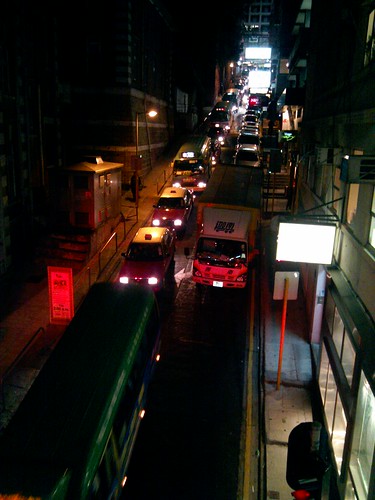
HK at night in Kowloon

On the evening of April 11, 2008 (see part 1), I was supposed to find Cattle Depot Artists’ Village, but instead missed my stop and landed on the other side of the old Kai Tak airport, close to Choi Hung MTR station. (

see map)

Undeterred by the prospect of adventure (there may have been simpler means to find my way back) I eventually walked, mapless, into Wong Tai Sin, through Kowloon City (and the former walled city too), and a circle around To Kwa Wan / Ma Tau Kok. Two hours and a half later, these are the best pictures that I took.

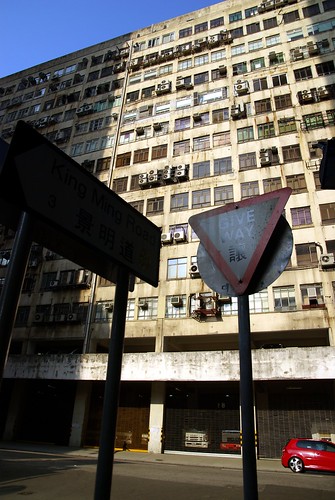
It’s a different environment from what I am used to on Hong Kong Island and its commercial buildings. Instead, I saw buildings associated with the old Kai Tak airport, endless rows of garages (and mod shops), outdoor restaurants, and affordable public houses.

***

Le soir du 11 avril 2008 (voir 1ère partie), je devais me rendre au Cattle Depot Artists’ Village, mais j’ai manqué mon arrêt et ai descendu de l’autre côté de l’ancien aéroport Kai Tak, près de la station de MTR Choi Hung. (

voir carte)

Au lieu de m’en faire (il y a des moyens plus facile pour se retrouver), j’ai décidé de partir à l’aventure et de retourner à la destination voulue à pied. Je me suis éventuellement guidé, sans carte, vers Wong Tai Sin, ai passé à travers Kowloon City (incluant l’ancienne ville fortifiée) pour finalement faire une boucle sur To Kwa Wan / Ma Tau Kok. Deux heures et demie plus tard, ce sont ici les meilleures photos que j’ai prises.

C’est un paysage urbain différent de celui dont je suis habitué du côté de l’île de Hong Kong et ses immeubles commerciaux. Au lieu de cela, j’ai vu des bâtiments associés à l’ancien aéroport, des rangées de garages (et mod shops) à n’en plus finir, des restos extérieurs, et des logements publiques à prix abordable.

“Blogging is more about fun than anti-censorship crusades”

Sunday, May 18th, 2008

SCMP - Blogging is more about fun than anti-censorship crusades

In the South China Morning Post of March 30th, 2008, the “Changing Faces” column meets with Steven Lin Jiashu (林嘉澍), the blogger behind Antiwave. He and his colleague Randy Jiang, aka “Pingke”, make commentary on current issues and produce interviews with people not heard on mainstream radio. “One of my favourite projects is an interview with Time magazine reporter Simon Elegant and blogger Vicky Yang. Simon interviewed Vicky in his report China’s me generation, a cover story for the magazine’s November (2007) issue.”, says Lin in the interview he gives in the SCMP.

***

Dans le South China Morning Post du 30 mars 2008, la chronique « Changing Faces » rencontre Steven Lin Jiashu (林嘉澍), le blogueur derrière le Antiwave. Lui et son collègue Randy Jiang, alias « Pingke », font du commentaire sur des sujets actuels et produisent des entrevues avec des gens négligés par la radio grand public. « L’un de mes projets favoris fut une entrevue avec le journaliste du magazine Time Simon Elegant et la blogueuse Vicky Yang. Simon avait interviewé Vicky dans son reportage China’s me generation, un article en page couverture de l’édition de novembre (2007). », raconte Lin dans l’entrevue qu’il donne au SCMP.

Sunshine in Hong Kong

Saturday, May 10th, 2008

Sunny day in Hong Kong

Mid-levels escalator in Central, Hong Kong

Ding-Ding - 2HKD

Taken this Thursday, in Hong Kong.

九記牛腩 (kao kee ngau lam) curry noodles in Central

Friday, May 9th, 2008

九記牛腩, Central, Hong Kong

On Thursday for lunch, one of my uncles took me to one of those famous places that only locals know, a curry noodles place in Central called 九記牛腩 (literally “nine & co. beef brisket”). Everything is written in Chinese, including its sign! (At our table, sat Asian-looking English-speakers) The menu is one of those minimalistic ones: three kinds of noodles (yii mein, ho faan, mai faan), two kinds of soup base (curry or broth).

Lisez la suite de cet article / Read the rest of this entry »

Hong Kong Central Library in Causeway Bay

Thursday, May 8th, 2008

Hong Kong Central Library

My Internet hole in Hong Kong is the Central Library located in Causeway Bay.

Lisez la suite de cet article / Read the rest of this entry »

This relay was sponsored by…

Saturday, May 3rd, 2008

Olympic torch in Hong Kong - May 2, 2008

This is expected and nothing really out of the ordinary: the Olympic torch relay in Hong Kong was heavily sponsored. Samsung flags and thundersticks (with Beijing logos too) were handed out to the people lining the streets.

Olympic torch in Hong Kong - May 2, 2008

Here was a whole delegation wearing these green or red t-shirts and red caps with Coca-Cola’s signature. The torch group was preceded by a Coca-Cola truck (along with an official car, if I remember correctly), that hinted to the crowd that what they came to see was approaching.

“Sai Kung bus crash”: the bad news in China

Saturday, May 3rd, 2008

Newsstand in North Point

What made the news in Hong Kong on May 1st wasn’t the Labour Day march, but rather this bus crash out in the New Territories burgh of Sai Kung. 17 people died and 45 more were injured.

This comes another transport accident, involving two trains colliding in Shandong province, with one of the trains on a high-speed route between Beijing and the port town of Qingdao, where sailing events for the Olympics are to be held.

Labour Day march in Hong Kong

Friday, May 2nd, 2008

Labour Day 2008 march in Hong Kong

Just like three years ago when I bumped into the annual Establishment Day march (July 1st), I again bumped into another march, this time for Labour Day, May 1st. I was walking in Wan Chai, near the small basketball court (nor Southorn), when I saw the local police cordoning off the left-most lane of Hennessy Road, one of Hong Kong Island’s main artery (where the tram circulates). I first thought that they were doing some sort of repetition for today’s Olympic flame march, but it wasn’t the case, clearly as I saw the people with loudspeakers chanting familiar labour union slogans in Cantonese.

>> Listen to the march passing in Wan Chai (~25mins – 11Mb)

I would say that a good half of the marchers were migrant workers, usually what seemed to be domestic helpers as they are usually called. Can’t quote a number for this entry, but a majority of middle-class families employs domestic helpers in Hong Kong. They typically come from the Philippines, but based on the posters I’ve seen, also from Nepal, Thailand, and Indonesia. On this public holiday, they took the street on their day off (who aand chanted “ga yaan gong”, for “raise salary”.

It was a small, peaceful march. I am going to see the Olympic torch today in Wan Chai, the last leg of its passage in Hong Kong. That is, if I can get even get near the path!

Flickr set of the event

Tomorrow, the Olympic torch is in Hong Kong

Thursday, May 1st, 2008

Beijing Olympic Torch Relay in HK

I arrived in Hong Kong on Tuesday night. Tomorrow, the Olympic torch relay is coming to town!

Lisez la suite de cet article / Read the rest of this entry »

Hong Kong’s independent artistic scene

Friday, April 18th, 2008

Danger Radio Hazard

Bande À Part published my last article on the artistic scene in Hong Kong.

The Beijing Olympics in Hong Kong

Tuesday, April 15th, 2008

Hong Kong Tramway colored Olympics 2008

While my hometown is hockey, my temporary one is Olympics. While not overly in-your-face to the point of seeing only that, the Beijing Olympics are quite noticeable in Hong Kong. It is a lot more than it is in Canada (more so because of the volume of advertisement here, I think) and the ads are not necessarily associated with commercial partnerships, as demonstrated in the previous picture of a Hong Kong tramway. Hong Kong people strongly support the Olympics (see opinion poll), and the feeling about the Olympics here is a far cry from the sentiment felt in Western countries.

Moreover, equestrian competitions for the 2008 Olympics are to be held in Hong Kong, for hygiene reasons, and probably also because of the territory’s long horse racing tradition.

I was in Taiwan last week for a week, and any Olympics-related advertisement was nowhere to be seen (but I did not go look for it).

I am about to board my flight for Beijing, so I might be able to tell you in a week how it compares!