Archive for August, 2008

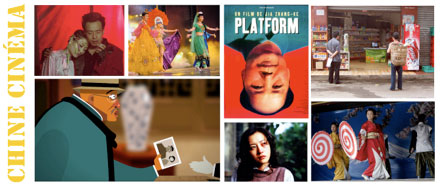
« Chine Cinéma » at the Cinémathèque québécoise

Saturday, August 30th, 2008

Chine Cinéma à la Cinémathèque québécoise

From September 2rd until November 30th, the Cinémathèque québécoise, on De Maisonneuve corner of St-Denis, will be presenting Chine Cinéma, a sort-of festival (but not really, because it spans three months…) of movies from the Chinese Mainland. Jia Zhangke will be particularly celebrated during the season, with all of his movies, including early short films that he made, such as Pickpocket (Xiao Wu), being shown.

I’d see all of them, if I could afford it (in time and money), but I’ve noted a couple of must-see films. In no particular order: All Tomorrow’s Parties (Mingri tianya) (which is by Nelson YU Lik-wai, not Diao Yinan, as noted in the online guide), a sort of dystopian future film, Summer Palace, some romantic film on backdrop of the 1989 near-revolution, She Is Automatic (a New Pants music video, ha-ha!), which is part of a series of animated shorts, Mid-Afternoon Barks, Fujian Blue, and Taishi Village, a documentary by Ai Xiaoming on one of the well-known cases of “mass incidents” in China.

Natural Q (自然捲) – C’est La Vie / 魚罐頭 / 30 years old hereafter

Tuesday, August 26th, 2008

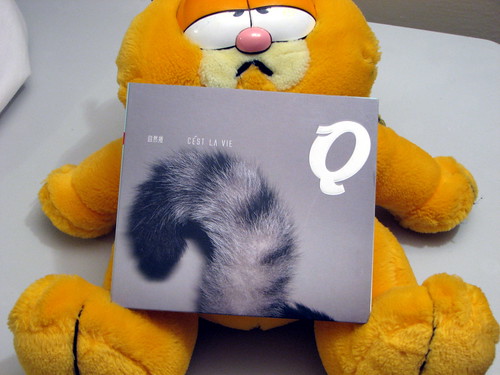
自然捲 - C'est La Vie

Semaine du 26 août 2008 / Week of August 26th, 2008

Cette chronique hebdomadaire sur la musique indépendante chinoise est diffusée à Radio Centre-Ville (102.3FM), les mardis entre 22h30 et 23h30. L’émission complète est disponible sur ce fichier MP3, à partir du lendemain de l’émission.

This weekly segment on independent Chinese music is broadcasted every Tuesday between 10:30PM and 11:30PM on Radio Centre-Ville (102.3FM). The full-length show is available at this MP3 file, starting from the day following the show.

***

1. C’est La Vie
2. 魚罐頭 (canned fish)
3. 30 years old hereafter (live_acoustic)

My friend Jen recently left Montreal and gave me her copy of Natural Q‘s first album “C’est La Vie” that she used to own. It was a big indie hit in Taiwan and Chinese-speaking territories, and is, as it should, out of print. It was the first release by A Good Day Records, now a prominent independent label in Taiwan.

I failed to mention it when I recorded the segment last week, but Natural Q actually released a new album last month.

Natural Q as it was known in 2004 (or 2003, when it started) no longer existed after 2006, when female vocalist Waa and Chico split, with Chico keeping custody of the band’s name, and periodically releasing stuff afterwards. The third song (optional, depending on whether Goo Por Yvonne can fit it all) comes from such album, just called “Recycles”, and from Natural Q’s “solo” period.

I don’t know why they split, anyhow. So enlighten me, if you do know all the gossip.

(Song 魚罐頭, or “canned fish”, is the first song in Natural Q’s still-together second album, C’est La Vie 2.)

Maman, c’est fini! (the 2008 Olympiads, that is)

Monday, August 25th, 2008

Beijing 2008 Olympics @ Montréal Chinatown

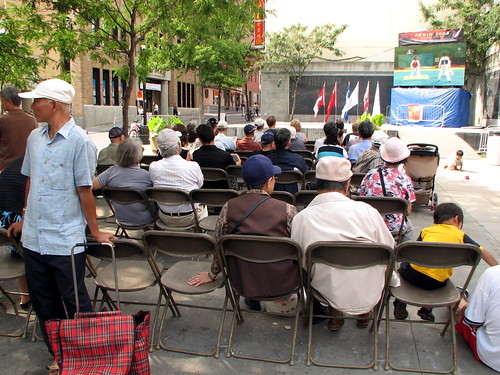
It’s hard to believe that the Olympics are now finished! “F-I-NI, fini”, as you would say in the local idioms. This was a picture taken this Saturday of the outdoor presentation of the Radio-Canada’s coverage of the Beijing Games, from 9 to 9, in Parc Sun Yat-sen at the heart of Montreal’s Chinatown. It was a remarkable use of this public space, as people of all ages gathered to watch.

Beijing 2008 Olympics @ Montréal Chinatown

J’adore le vombrissement d’un scooter quand je me réveille le matin

Thursday, August 21st, 2008

Taichung, Taiwan
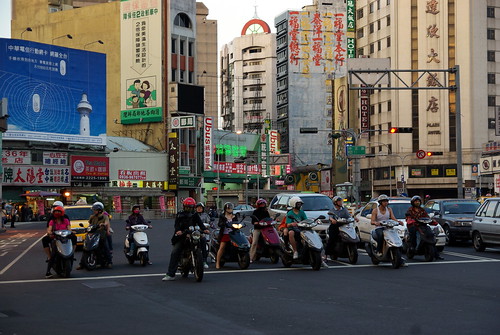
Scooters à Taichung / Scooter in Taichung

This morning, on my way to work, I heard the vroom of a scooter. In Montreal, this may only happen in the four, five months when motorized bike riding isn’t a danger due to climatic hazards.

I like the sound because it reminds me of Asia, and especially Taiwan, where the scooter is king. Not so much of China, where its use in the city is either prohibited or costs so much in license that you’d be better to get a car. And it’s for a good reason too – any Chinese city would disappeared under an even thicker cloud of grayish pollution.

***

Ce matin, en me rendant au travail, j’ai entendu le vombrissement d’un scooter. À Montréal, ça peut seulement se produire dans les quatre ou cinq mois durant lesquels la conduite d’un bicycle motorisé n’est pas un danger lié à un climat hazardeux.

J’aime ce son parce que ça me rappelle l’Asie, et plus particulièrement Taiwan, où le scooter est roi. Pas trop la Chine, où son utilisation en ville est soit interdite ou que le coût élévé d’obtention d’un permis voudrait dire qu’il vaudrait mieux se procurer une voiture. Et il y a une bonne raison derrière ça : n’importe quelle ville chinoise disparaîtrait sous un nuage gris de polution encore plus épais.

Ourselves Beside Me

Wednesday, August 20th, 2008

Ourselves Beside Me's Li Yangfan

Semaine du 19 août 2008 / Week of August 19th, 2008

Cette chronique hebdomadaire sur la musique indépendante chinoise est diffusée à Radio Centre-Ville (102.3FM), les mardis entre 22h30 et 23h30. L’émission complète est disponible sur ce fichier MP3, à partir du lendemain de l’émission.

This weekly segment on independent Chinese music is broadcasted every Tuesday between 10:30PM and 11:30PM on Radio Centre-Ville (102.3FM). The full-length show is available at this MP3 file, starting from the day following the show.

***

Malheureusement, je déménage cette semaine, et mon nouveau service d’Internet (Bell Internet Total, pour ne pas le nommer), après un retard / erreur de livraison, ne pourra être activé avant peut-être de trois à six jours. Au moins, j’ai le dial-up (oui oui, j’ai un modem téléphone dans mon portable), alors je peux au moins vous écrire quelques mots sur Ourselves Beside Me, faute de pouvoir téléverser leur chansons…

Well, the songs that were played tonight were from a recording made by a friend’s friend’s friend (who are Chinese currently or formerly living in Beijing). Apparently, the CBC had a piece on rock music, specifically on the D-22. Despite being a relatively new band, Ourselves Beside Me (sic) are regulars at the live house in the northwestern district of universities (walking distance from Tsinghua and Beida, the two most prestigious Chinese universities). OBM started around the end of 2007, and I think that this recording was made during a show at the D-22 (or the Mao?) in the Spring.

OBM is characterized as a “post-punk revival band”. It does have a really classic sound. One band member was with Hang on the Box, but it sounds nothing like them. It’s more low-key than HotB – very good music to pass out on a couch with a couple of beer bottles under your belt.

I went to the D-22 as well, in mid-April, when OBM opened for Vancouver-based You Say Party! We Say Die! I recorded the whole show with my portable voice recorder. The quality isn’t great, but the recording of OBM’s performance is still up on this previous post. I’ll put up the songs if home Internet will finally arrive.

Carol Huynh wins first olympic gold for Canada

Saturday, August 16th, 2008


Photo: Jeyhun Abdulla/Associated Press.

Eh bien, finalement une médaille pour le Canada! Et je me demandais bien si elle était d’origine chinoise: selon un article dans le Vancouver Sun, son père Viem est effectivement un Chinois du Vietnam. “Huynh”, ça donne “Huang” en mandarin ou “Wong” en cantonnais (黃, c’est le caractère pour “jaune”) – le même nom de famille que ma mère.

Mise à jour: En me réveillant le matin, j’apprends qu’elle a gagné l’or en battant la championne du monde Icho! L’or, en chinois, ça s’écrit 黃金 (huáng jīn), ou “jaune métal”!

***

Finally a medal for Canada! And I was wondering whether she was of Chinese origin, and according to a Vancouver Sun article, her dad Viem is indeed Chinese from Vietnam. “Huynh” gives “Huang” in mandarin, and “Wong” in Cantonese (黃 is the character for “yellow”) – my mother’s maiden name.

Update: As I woke up this morning, I find out that she wins gold by beating the wold champion Icho! Gold, in Chinese, is written 黃金 (huáng jīn), or “golden metal”!

Twelve live feeds from the Beijing Olympics for Canada

Friday, August 15th, 2008

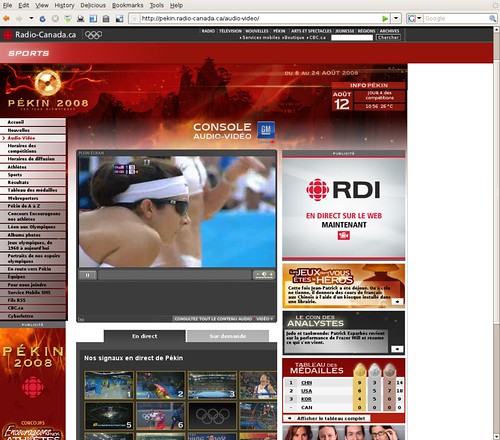
Les Jeux olympiques de Pékin 2008 sur Radio-Canada.ca

One of the most interesting features of Radio-Canada’s Beijing 2008 website (the official national broadcaster for the Games in Canada) is the twelve live streams on its audio-video zone. They were splitted from the broadcasting centre in Montreal, and directly re-transmitted on the web, geo-localized for Canada. The “wall” of video previews below the video embed allows you to browse between the channels.

Perhaps what’s cool about these steams is the total absence of commenting on the eleven other feeds not currently being used for traditional television broadcast. On Sunday, I watched 3/4 of the USA-China game on channel #5, without hearing any of the commentators, emphasizing on the crowd’s reaction, and even what the players were saying/cursing on the court (and also the bad Chinese pop).

On Friday, I watched rowing competitions, baseball, softball, then a few judo matches. Without the commentators’ voiceovers, it almost makes you feel as if you were in the crowd in Beijing. I have a feeling that this is what the future of media tends towards: empowering audiences with omnipresence through one’s television screen (or computer monitor).

Click on this (if you are living in Canada):
http://pekin.radio-canada.ca/audio-video/

This is definitely one of the ground-breaking features coming from Radio-Canada.ca during these games (with daily interactive clips Les jeux dont vous êtes le héros) that CBC.ca or other larger media corporations just won’t offer.

À l’heure de la Chine : La liberté d’expression

Thursday, August 14th, 2008

À l’heure de la Chine : Radio-Canada

La qualité de l’émission quotidienne présentée pendant les Jeux sur la télé de Radio-Canada m’impressionne grandement. On est à l’occasion critique envers la Chine, mais on le fait toujours vec les grains de sel qui s’imposent. Vraiment un chef-d’oeuvre de journalisme. (lien vers les émissions intégrales)

Dans l’émission d’aujourd’hui, Don Murray nous raconte bien comment les choses ont évolué en Chine, sans que ça ne soit tout à fait la totale libre expression. Dans la même veine, le blogueur de ESWN, me disait un peu en blague que si on choisissait dix articles sur un forum de discussion quelconque en Chine, et qu’on les postait sur un forum d’il y a 10 ans, sans doute que 9 sur 10 se feraient arrêter.

J’aurais bien aimé entendre parler du travail fait par le Southern Metropolis/Weekly, mais ça ira pour un autre reportage sans doute. Par exemple, ils ont récemment rencontré le fondateur sud-africain de Danwei.org, l’un des sites en anglais les plus lus de Chine, et prennent soin de rencontrer les gens qui font les news, comme le secrétaire de parti au Sichuan qui s’est promené à genoux, ou les supposés accusés dans l’affaire de Weng’an.

Et puis comme “observateur” des médias, je trouve que ça clenche bien la couverture en marge des jeux que fait les cousins de la CBC (en tout cas, de ce que je peux observer via le web).

Up the Yangtze is back at the AMC during the Olympics

Thursday, August 14th, 2008

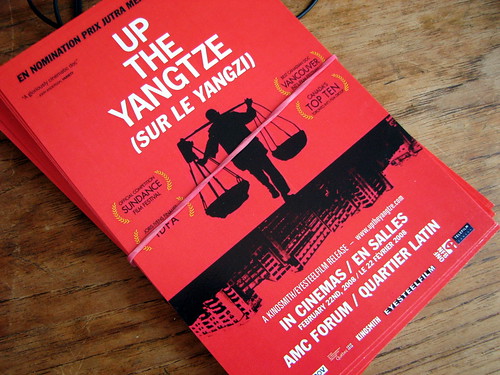
Sur le Yangzi / Up the Yangtze

If you didn’t see Canadian-born Chinese Yung Chang‘s film Up the Yangtze (Sur le Yangzi, en version française), here’s your chance:

Back by popular demand, Up the Yangtze will return to theatres this Friday August 15 for an open run at Montreal’s AMC Forum. The epic documentary provides another face to China not shown during the Olympic Games, exploring the lives of people living along the Yangtze River, forced to deal with flooding from the massive Three Gorges Dam.

The movie is presented in English with Mandarin subtitles. Dolby 5.1, 95 minutes, 35mm.

Beijing’s Blue Screen of Death

Wednesday, August 13th, 2008

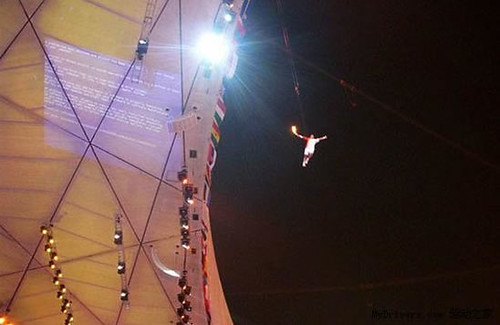
Blue Screen of Death @ Beijing Olympics opening ceremony

From Rivercool, via Hecaitou’s blog, via EastSouthWestNorth.

Comme les Chinois typically tries not to just re-post news published somewhere else, but this is just too good to keep for myself. There has been talk about the fake singing, the sequences that would’ve been added in case of rain, but the geek in me (and IT specialist by trade), insists that this is the best part of the opening ceremony to pick on.

Yes, what you see on the picture, as torchbearer Li Ning is flying in, is Microsoft’s signature blue screen of death!

Sulumi – 10 Billion Times / Trembling Stars / Your Lips

Tuesday, August 12th, 2008

Sulumi

Semaine du 12 août 2008 / Week of August 12th, 2008

Cette chronique hebdomadaire sur la musique indépendante chinoise est diffusée à Radio Centre-Ville (102.3FM), les mardis entre 22h30 et 23h30. L’émission complète est disponible sur ce fichier MP3, à partir du lendemain de l’émission.

This weekly segment on independent Chinese music is broadcasted every Tuesday between 10:30PM and 11:30PM on Radio Centre-Ville (102.3FM). The full-length show is available at this MP3 file, starting from the day following the show.

***

1. Trembling Stars (see artist website)
2. 10,000,000,000 Times, remixed by USK (see artist website)
3. Your Lips

It’s the Beijing Olympics, so I’ll be playing another artist from the Chinese capital. After presenting a number of rock bands, here is something different. Sun Dawei is better known as Sulumi, a chiptune artist living in Beijing. Chiptune, quésséssa? It’s basically the music of 8-bit, of Gameboy, the NES, and the rest of the so-called Third generation video consoles. In fact, Sulumi’s music often sounds like the soundtrack of your favourite Gameboy game…

I particularly like its very energetic songs. It’s perfect for a high-octane programming drive. I tried finding his latest album, “what has happened to me in this world”, but couldn’t find any place online selling it (there must be, because he’s one of the major names in Chinese electronic music circulating within my networks). Its first song, which I am playing tonight, is very good. Unfortunately, you can’t even pirate his CD, if you are desperate. One thing you can do is buy his 2006 album Stereo Chocolate on iTunes. (I really should’ve looked for it in Beijing…)

What I managed to buy in Hong Kong was his collab with Japanese chiptune artist USK, called “As Vivid As Your Lips”. The last song, Your Lips, is from it. It’s a slow saucy song, that feels like a French-kissing session.

Sulumi started Shanshui Records, a record label, which recently organized a tour with Chinese and Japanese electronica artists across East Asia in May and June 2008. It stopped at Videotage in Hong Kong, a venue/art space that was run by Ashley Wong, the next after next guest on Regarde les Chinois (I am moving this week, so don’t expect the next for until later next week…).

Hats Off to Jujie

Monday, August 11th, 2008

Luan Jujie

Nope, Canada hasn’t won a single gold medal yet. One of the feel-good stories for Canada prior to the Games has been Luan Jujie, the Chinese-Canadian fencer who won Olympic gold in Los Angeles in 1984, while defending China’s colours (see article and video on Radio-Canada.ca).

My friend Rob Parungao used to fence, and his coach in Vancouver is a good friend of Luan, who now resides in Edmonton. He met her when she came to town for workshops. Rob has a new blog called When we see the Ocean, and he wrote about his encounter(s) with the fencer:

As I’m pretty good with kids I remember playing with her two daughters and son a lot back when they were kids since Paul, Mike and Jeremy were pretty much content hanging out in her basement listening to music and chatting. I remember her six year old Jerrica was rally outgoing had a crush on me which was kind of cute and her other daughter Jessica had Down’s syndrome. Her son was kind of quiet, but I won him over by giving him most of my Halloween candy which made him open up to me a bit.

Here, go check out the entire article.

Rocking it in the Chinese capital

Sunday, August 10th, 2008

Guai Li
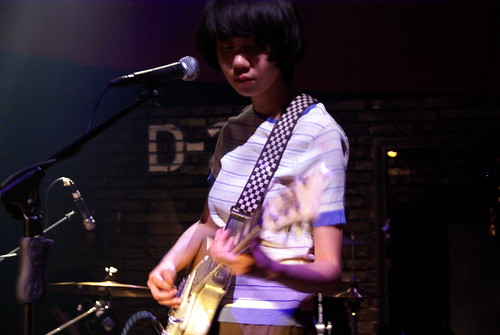
Beijing band Guai Li at D-22

Ceci est une traduction d’un texte que j’ai écrit pour le blogue de Bande à part, publié le 8 août 2008.

Last April, I was in East Asia to attend a rock music festival in Kenting, Taiwan, and then made a stop in Hong Kong, where I discovered small record stores.

During the same trip, I also spent two weeks in Beijing. My musical adventures started off quite ironically, as my hosts, an American-Chinese and a Briton, took me to see a concert fronted by You Say Party! We Say Die!, a party punk band from Vancouver, that happened to be touring China at the time!

The venue was called the D-22 and is located in the area close to Beijing University, where its founder, a Newyorker, also teaches finance. We were probably a crowd of a hundred-something people, half of which were foreigners, and the other half, presumably locals, on that Friday night, to fill the D-22, a bar just slightly larger than a closet (at most 10m of width).

Steven O'Shea of YSP!WSD!
Steven O’Shea of YSP!WSD!

YSPWSD, who played on the previous evening at the Mao Live, a venue located at the heart of Beijing, told me their amazement in front of this overcrowded, ever-changing megalopolis, and the fun they had performing in it. “Crowds are very receptive here! We didn’t have to prompt them to mosh: they took care of it for us!”, said Stephen O’Shea of YSP!WSD! before the show.

The opening show only started after 10:30PM, and the main act only came to stage after midnight. The local bands opening for YSP!WSD! were Candy Monster, Guai Li (see top photo), and Ourselves Beside Me (sic). Judging from the exodus of Chinese spectators from the front of the stage, after Ourselves Beside Me’s performance, we quickly took note that they were probably more well-known to locals.

After some research, I realized that one of its members, bassist Yangfan (see photo), was once a member of Hang On The Box, an all-girl punk band, and one of the most well-known to ever come out of China. Separated since their last album, in Fall 2007, which Yangfan already wasn’t part of, HotB was one of the bands followed in the documentary Beijing Bubbles. The German production also introduced us to other well-known bands of Beijing founded between 1996 and 2001, such as Joyside, New Pants, Sha Zi and T9.

Zuoxiao Zuzhou - Tiananmen
Poster of Beijinger Zuoxiao Zuzhou / 左小祖咒‘s 2001 album (左小祖咒在地安门), Overseas version. Seen at the Sugar Jar, for 100RMB.

The scene’s history cannot be told without mentioning Cui Jian, the one dubbed the godfather of Beijing rock. Cui, whose songs were once chanted by the students of Tian’anmen Square in 1989, fled to the mountains of Yunnan, in the country’s Southwest, slightly after the events of June 4th, like many other rockers at the time. Since then, he has been rehabilitated, and now gives concerts in sold-out stadiums around the world, like in San Jose, California, in early May. Tang Dynasty and Black Panther are other well-known names from this period of the 1990s. Other bands in the meanwhile, like Brain Failure, regularly toured Europe and the USA.

Local bands touring around the world: not too rare (when will they decide to make a stop in Montreal?). Lee Clow, an American expatriate, who lived in Beijing for 8 years, explains that the rule is that if they are popular in the West, generally, they would be in only one country! “Joyside, it’s in Germany, and Brain Failure, good for them, it’s in the US!” Clow has himself been part of a band called End of the World, practically the only ska band in Beijing, because of longevity.

In the last days of my stay in Beijing, we talked about the most important music festival in the country, the Midi Music Festival, named after Beijing’s contemporary music school being reported. Usually held around the May 1st public holiday since 1997, in Haidian park, in the universities district, “Midi” gets between 40,000 and 80,000 spectators each year. But this year, as it was the case in 2003 (because of SARS) and in 2004, police asked the organizers to delay their event until the October 1st national day.

Rockland 摇篮 music store @ Houhai, Beijing
Rockland 摇篮 music store and its owner, Xiao Zhan, in Houhai since 2004.

Before leaving Beijing, I went wild at local music shops. More accessible from the city’s centre, there’s the Rockland, established in 2004 in Houhai, a lake around which were built bars and restaurants for tourists and young rich people.

I bought a number of safe bets, like Joyside’s latest, and also the current new hot property Carsick Cars‘ (they were in Time Magazine’s July 17th, 2008 edition) only album. Both were published by the Maybe Mars label. I also picked up an electro compilation, and an album from a folk rock signer named Wan Xiaoli of independant Modern Sky. You might also this type of good self-made albums circulating at 100 copies.

One of the best-known independent record stores in town is the Sugar Jar, located in the 798 art zone, old military warehouses recycled as an art and design zone.

Sugar Jar
Jewel case wall at the Sugar Jar.

Aside from selling CDs, tiny Sugar Jar may also be fitted as a performance room. That’s where Joshua Frank, a McGill student who spends the rest of his year in Beijing, and the experimental rock band Hot & Cold that he completes with his brother, occasionally plays. His brother also happens to be in a band with Carsick Cars’ Shouwang, frequently lauded as China’s new guitar icon.

On the electronic music scene, the name that circulated in conversations and promotional posters was Sulumi (real name Sun Dawei), a chiptune musician. Shanshui, the label that he started, just organized an Asian tour with other Chinese and Japanese artists. Among recommendations in this genre, there was an interesting electronic mix of Yi ethnic minority music.

好听 / 嘘
Pleasant to the ear / Lies!

After throwing all these names at you, what can you do to discover more Chinese indie music? The first thing to do is to look at a Chinese site called Neocha (in English: New-Tea), or listen to its Next web radio.

798
Random graffiti at 798 – the only place in Beijing you will see graffitis!

Beijing Olympics opening ceremony in Montreal Chinatown

Friday, August 8th, 2008

Beijing Olympics @ Montréal Chinatown

This morning, I woke up much earlier than usual to watch the opening ceremony to the 2008 Olympic Games in Chinatown.

On montrait les Jeux Olympiques au travail sur écran géant, mais par hasard, j’ai entendu à la radio qu’on les montrait aussi sur écran géant au Quartier chinois…

>> Voir toutes les photos / See all photos

Beijing Olympics @ Montréal Chinatown

Beijing Olympics @ Montréal Chinatown

Beijing Olympics @ Montréal Chinatown

Beijing Olympics @ Montréal Chinatown

Beijing Olympics @ Montréal Chinatown

Beijing Olympics @ Montréal Chinatown

Beijing Olympics @ Montréal Chinatown

Nanluogu Xiang à Beijing: hutongs pour les touristes

Wednesday, August 6th, 2008

Nanluogu Xiang - Beijing

An English version of this article was published on Spacing Montreal and Spacing Toronto.

Au cours de ma première semaine à Beijing en avril dernier, mon hôte, une Américaine d’origine chinoise vivant à Beijing, n’a cessé de m’encourager à aller faire un tour à Nanluogu Xiang (Chemin Nanluogu or 南锣鼓巷 en caractères chinois), une ruelle étroite (aussi appelées des « hutongs ») typique de Beijing, au coeur de la ville, maintenant bordée des magasins branchés et cafés style occidental. Ça rappelle le Vieux-Montréal…

Nanluogu Xiang est situé sur l’axe central de Beijing. Faisant l’objet d’un article sur le site officiel des Jeux Olympiques de Beijing, ce hutong est parmi les plus célèbres de la ville et s’est vu attribuer un statut spécial depuis 2006.

Nanluogu Xiang - Beijing

Ça n’a été qu’à la fin de ma deuxième semaine à Beijing que j’aie finalement pu m’y promener, et ce, un peu par accident. Après mon repas de jiaozi (dumplings/raviolis chinois), l’ami né en Ontario, d’origine chinoise avec qui j’étais allait me faire faire le tour du quartier où il vivait, qui se trouvait juste un peu plus loin après le Nanluogu Xiang! Étudiant en médecine chinoise, il a commencé à louer une chambre (c’est un 3 1/2, en termes montréalais) dans une maison traditionnelle pourvue d’une cour, non loin de là, pour à peu près l’équivalent de 275 de nos huards.

Quand il a initialement déménagé dans le quartier, il se rappelle que Nanluogu Xiang ne ressemblait en rien à ce que c’est aujourd’hui (comme me le confirme d’autres amis qui ont vécu à Beijing à l’époque). Sur la ruelle qui s’étend sur un kilomètre entre Gulou Dajie (avenue de Gulou) et la rue Di’anmen, où donne aussi la face ouest de l’École d’art dramatique centrale, (où Zhang Ziyi et d’autres noms du cinéma chinois ont étudié), il n’y avait en fait que deux cafés.

Nine-Thirty - Nanluogu Xiang - Beijing

En 2008, on y trouve maintenant toutes sortes de commerces, comme le Nine-Thirty, un café Hongkongais avec wifi et projection quotidienne de film, ou un bar-salon de thé avec des spectacles de musique (voir photo ci-bas), comme le Sandglass Café, appartenant à ses deux amis dans la fin vingtaine d’origine ethnique mongolienne, ou encore, un magasin de t-shirts concept comme Plastered qui joue sur des points de repère de Beijing (j’en ai acheté un avec un ancien billet de métro dessus).

Mongolian music

NLGX

La chance a frappé à nouveau, le lendemain, quand je suis retourné à Nanluogu Xiang en suivant ma propre route. Alors que je marchais d’un bout à l’autre du hutong, des t-shirts au design particulier suspendus à la vitrine d’un des magasins ont attiré mon attention. Après le mot de bienvenue standard débutant par « Ni hao », le propriétaire du magasin change à l’anglais pour me dire qu’il était en fait né à Montréal!

Avec ses deux amis chinois d’outre-mer, Raymond Walintukan (lisez l’entrevue réalisée avec eux) a fondé NLGX (l’acronyme de Nanluogu Xiang), un café/magasin de design et de style de vie. Parlant de leur terrasse sur le toit qui surplombe Nanluogu Xiang, il m’explique que la zone entière a été reconstruite et est protégée par le gouvernement municipal, et que le quartier ne changera pas pour des décennies à venir.

Nanluogu Xiang - Beijing

Parmi les boutiques branchées, des gens vivent encore dans des maisons traditionnelles d’une ou deux étages. Lors de ma troisième visite, j’ai pris une photo, sans me gêner, d’un homme qui était en train de se faire à souper. Il faut dire, quand même, que sa porte donnait directement sur la ruelle!

Nanluogu Xiang - Beijing

Un panneau interdisant la circulation automobile pouvait être aperçu à l’un des bouts de Nanluogu Xiang, sauf que, comme celui sur la photo ci-dessus, personne n’avait l’air de s’en préoccuper…

Nanluogu Xiang - Beijing