Archive for the ‘Beijing’ Category

Hot and Cold

Tuesday, September 16th, 2008


Photo published in the McGill Daily.

Semaine du 16 septembre 2008 / Week of September 16th, 2008

Cette chronique hebdomadaire sur la musique indépendante chinoise est diffusée à Radio Centre-Ville (102.3FM), les mardis entre 22h30 et 23h30. L’émission complète est disponible sur ce fichier MP3, à partir du lendemain de l’émission.

This weekly segment on independent Chinese music is broadcasted every Tuesday between 10:30PM and 11:30PM on Radio Centre-Ville (102.3FM). The full-length show is available at this MP3 file, starting from the day following the show.

***

1. Rabies + Dance to this Motherfucker (zipped)

This week’s band is in fact not really Chinese, but its band members live in China during the off season. Brothers Joshua and Simon Frank form the Hot & Cold, a sometimes-Montreal, sometimes-Beijing, sometimes-Shanghai “experimental” rock band.

Rocking it in the Chinese capital

Sunday, August 10th, 2008

Guai Li
Beijing band Guai Li at D-22

Ceci est une traduction d’un texte que j’ai écrit pour le blogue de Bande à part, publié le 8 août 2008.

Last April, I was in East Asia to attend a rock music festival in Kenting, Taiwan, and then made a stop in Hong Kong, where I discovered small record stores.

During the same trip, I also spent two weeks in Beijing. My musical adventures started off quite ironically, as my hosts, an American-Chinese and a Briton, took me to see a concert fronted by You Say Party! We Say Die!, a party punk band from Vancouver, that happened to be touring China at the time!

The venue was called the D-22 and is located in the area close to Beijing University, where its founder, a Newyorker, also teaches finance. We were probably a crowd of a hundred-something people, half of which were foreigners, and the other half, presumably locals, on that Friday night, to fill the D-22, a bar just slightly larger than a closet (at most 10m of width).

Steven O'Shea of YSP!WSD!
Steven O’Shea of YSP!WSD!

YSPWSD, who played on the previous evening at the Mao Live, a venue located at the heart of Beijing, told me their amazement in front of this overcrowded, ever-changing megalopolis, and the fun they had performing in it. “Crowds are very receptive here! We didn’t have to prompt them to mosh: they took care of it for us!”, said Stephen O’Shea of YSP!WSD! before the show.

The opening show only started after 10:30PM, and the main act only came to stage after midnight. The local bands opening for YSP!WSD! were Candy Monster, Guai Li (see top photo), and Ourselves Beside Me (sic). Judging from the exodus of Chinese spectators from the front of the stage, after Ourselves Beside Me’s performance, we quickly took note that they were probably more well-known to locals.

After some research, I realized that one of its members, bassist Yangfan (see photo), was once a member of Hang On The Box, an all-girl punk band, and one of the most well-known to ever come out of China. Separated since their last album, in Fall 2007, which Yangfan already wasn’t part of, HotB was one of the bands followed in the documentary Beijing Bubbles. The German production also introduced us to other well-known bands of Beijing founded between 1996 and 2001, such as Joyside, New Pants, Sha Zi and T9.

Zuoxiao Zuzhou - Tiananmen
Poster of Beijinger Zuoxiao Zuzhou / 左小祖咒‘s 2001 album (左小祖咒在地安门), Overseas version. Seen at the Sugar Jar, for 100RMB.

The scene’s history cannot be told without mentioning Cui Jian, the one dubbed the godfather of Beijing rock. Cui, whose songs were once chanted by the students of Tian’anmen Square in 1989, fled to the mountains of Yunnan, in the country’s Southwest, slightly after the events of June 4th, like many other rockers at the time. Since then, he has been rehabilitated, and now gives concerts in sold-out stadiums around the world, like in San Jose, California, in early May. Tang Dynasty and Black Panther are other well-known names from this period of the 1990s. Other bands in the meanwhile, like Brain Failure, regularly toured Europe and the USA.

Local bands touring around the world: not too rare (when will they decide to make a stop in Montreal?). Lee Clow, an American expatriate, who lived in Beijing for 8 years, explains that the rule is that if they are popular in the West, generally, they would be in only one country! “Joyside, it’s in Germany, and Brain Failure, good for them, it’s in the US!” Clow has himself been part of a band called End of the World, practically the only ska band in Beijing, because of longevity.

In the last days of my stay in Beijing, we talked about the most important music festival in the country, the Midi Music Festival, named after Beijing’s contemporary music school being reported. Usually held around the May 1st public holiday since 1997, in Haidian park, in the universities district, “Midi” gets between 40,000 and 80,000 spectators each year. But this year, as it was the case in 2003 (because of SARS) and in 2004, police asked the organizers to delay their event until the October 1st national day.

Rockland 摇篮 music store @ Houhai, Beijing
Rockland 摇篮 music store and its owner, Xiao Zhan, in Houhai since 2004.

Before leaving Beijing, I went wild at local music shops. More accessible from the city’s centre, there’s the Rockland, established in 2004 in Houhai, a lake around which were built bars and restaurants for tourists and young rich people.

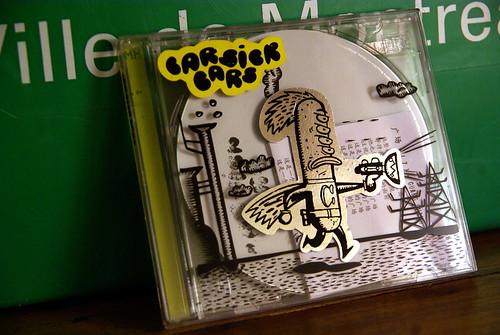
I bought a number of safe bets, like Joyside’s latest, and also the current new hot property Carsick Cars‘ (they were in Time Magazine’s July 17th, 2008 edition) only album. Both were published by the Maybe Mars label. I also picked up an electro compilation, and an album from a folk rock signer named Wan Xiaoli of independant Modern Sky. You might also this type of good self-made albums circulating at 100 copies.

One of the best-known independent record stores in town is the Sugar Jar, located in the 798 art zone, old military warehouses recycled as an art and design zone.

Sugar Jar
Jewel case wall at the Sugar Jar.

Aside from selling CDs, tiny Sugar Jar may also be fitted as a performance room. That’s where Joshua Frank, a McGill student who spends the rest of his year in Beijing, and the experimental rock band Hot & Cold that he completes with his brother, occasionally plays. His brother also happens to be in a band with Carsick Cars’ Shouwang, frequently lauded as China’s new guitar icon.

On the electronic music scene, the name that circulated in conversations and promotional posters was Sulumi (real name Sun Dawei), a chiptune musician. Shanshui, the label that he started, just organized an Asian tour with other Chinese and Japanese artists. Among recommendations in this genre, there was an interesting electronic mix of Yi ethnic minority music.

好听 / 嘘
Pleasant to the ear / Lies!

After throwing all these names at you, what can you do to discover more Chinese indie music? The first thing to do is to look at a Chinese site called Neocha (in English: New-Tea), or listen to its Next web radio.

798
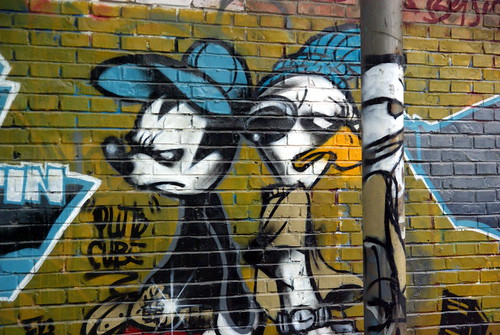
Random graffiti at 798 – the only place in Beijing you will see graffitis!

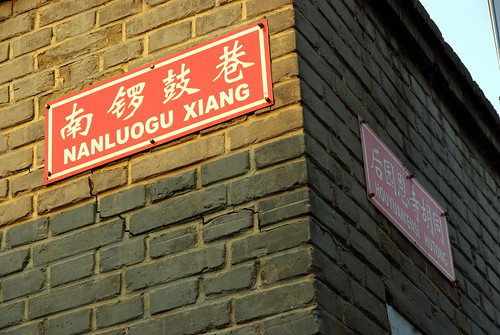
Nanluogu Xiang à Beijing: hutongs pour les touristes

Wednesday, August 6th, 2008

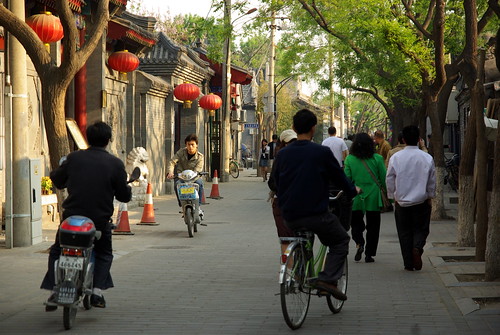
Nanluogu Xiang - Beijing

An English version of this article was published on Spacing Montreal and Spacing Toronto.

Au cours de ma première semaine à Beijing en avril dernier, mon hôte, une Américaine d’origine chinoise vivant à Beijing, n’a cessé de m’encourager à aller faire un tour à Nanluogu Xiang (Chemin Nanluogu or 南锣鼓巷 en caractères chinois), une ruelle étroite (aussi appelées des « hutongs ») typique de Beijing, au coeur de la ville, maintenant bordée des magasins branchés et cafés style occidental. Ça rappelle le Vieux-Montréal…

Nanluogu Xiang est situé sur l’axe central de Beijing. Faisant l’objet d’un article sur le site officiel des Jeux Olympiques de Beijing, ce hutong est parmi les plus célèbres de la ville et s’est vu attribuer un statut spécial depuis 2006.

Nanluogu Xiang - Beijing

Ça n’a été qu’à la fin de ma deuxième semaine à Beijing que j’aie finalement pu m’y promener, et ce, un peu par accident. Après mon repas de jiaozi (dumplings/raviolis chinois), l’ami né en Ontario, d’origine chinoise avec qui j’étais allait me faire faire le tour du quartier où il vivait, qui se trouvait juste un peu plus loin après le Nanluogu Xiang! Étudiant en médecine chinoise, il a commencé à louer une chambre (c’est un 3 1/2, en termes montréalais) dans une maison traditionnelle pourvue d’une cour, non loin de là, pour à peu près l’équivalent de 275 de nos huards.

Quand il a initialement déménagé dans le quartier, il se rappelle que Nanluogu Xiang ne ressemblait en rien à ce que c’est aujourd’hui (comme me le confirme d’autres amis qui ont vécu à Beijing à l’époque). Sur la ruelle qui s’étend sur un kilomètre entre Gulou Dajie (avenue de Gulou) et la rue Di’anmen, où donne aussi la face ouest de l’École d’art dramatique centrale, (où Zhang Ziyi et d’autres noms du cinéma chinois ont étudié), il n’y avait en fait que deux cafés.

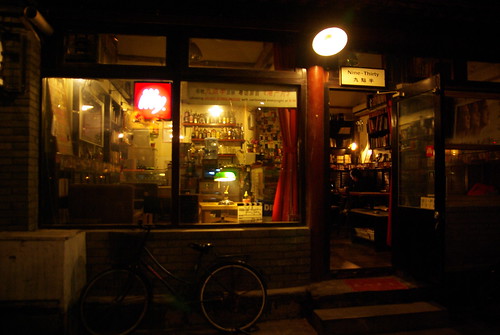
Nine-Thirty - Nanluogu Xiang - Beijing

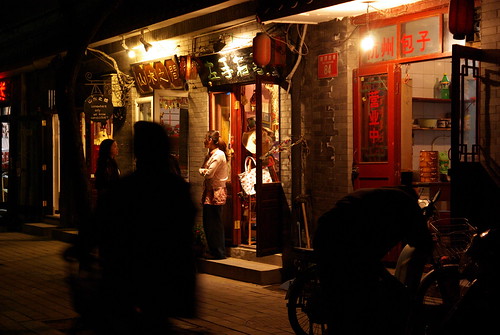
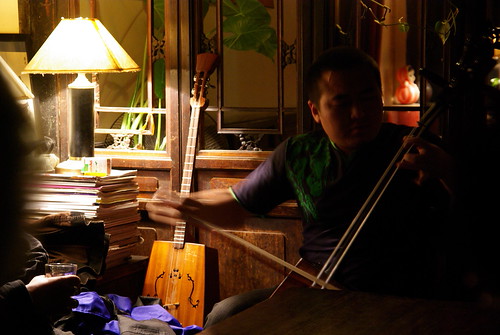
En 2008, on y trouve maintenant toutes sortes de commerces, comme le Nine-Thirty, un café Hongkongais avec wifi et projection quotidienne de film, ou un bar-salon de thé avec des spectacles de musique (voir photo ci-bas), comme le Sandglass Café, appartenant à ses deux amis dans la fin vingtaine d’origine ethnique mongolienne, ou encore, un magasin de t-shirts concept comme Plastered qui joue sur des points de repère de Beijing (j’en ai acheté un avec un ancien billet de métro dessus).

Mongolian music

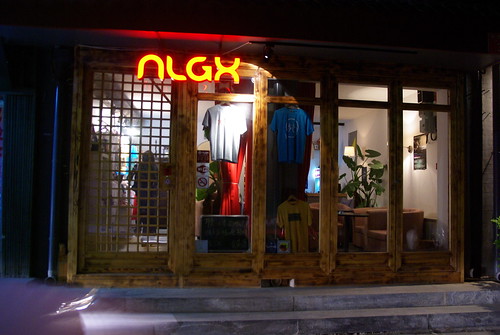
NLGX

La chance a frappé à nouveau, le lendemain, quand je suis retourné à Nanluogu Xiang en suivant ma propre route. Alors que je marchais d’un bout à l’autre du hutong, des t-shirts au design particulier suspendus à la vitrine d’un des magasins ont attiré mon attention. Après le mot de bienvenue standard débutant par « Ni hao », le propriétaire du magasin change à l’anglais pour me dire qu’il était en fait né à Montréal!

Avec ses deux amis chinois d’outre-mer, Raymond Walintukan (lisez l’entrevue réalisée avec eux) a fondé NLGX (l’acronyme de Nanluogu Xiang), un café/magasin de design et de style de vie. Parlant de leur terrasse sur le toit qui surplombe Nanluogu Xiang, il m’explique que la zone entière a été reconstruite et est protégée par le gouvernement municipal, et que le quartier ne changera pas pour des décennies à venir.

Nanluogu Xiang - Beijing

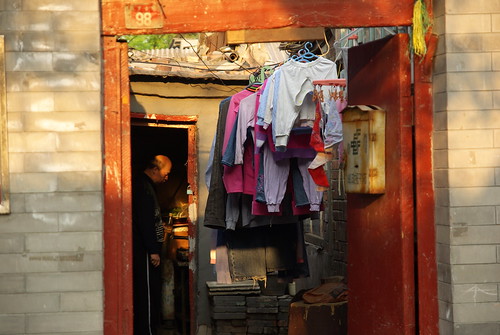
Parmi les boutiques branchées, des gens vivent encore dans des maisons traditionnelles d’une ou deux étages. Lors de ma troisième visite, j’ai pris une photo, sans me gêner, d’un homme qui était en train de se faire à souper. Il faut dire, quand même, que sa porte donnait directement sur la ruelle!

Nanluogu Xiang - Beijing

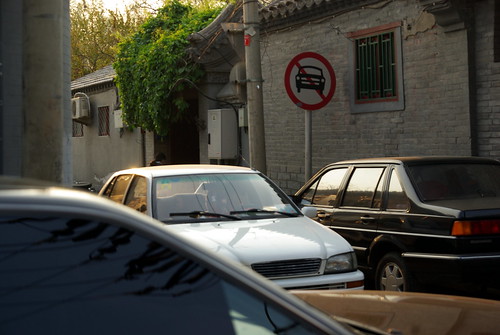
Un panneau interdisant la circulation automobile pouvait être aperçu à l’un des bouts de Nanluogu Xiang, sauf que, comme celui sur la photo ci-dessus, personne n’avait l’air de s’en préoccuper…

Nanluogu Xiang - Beijing

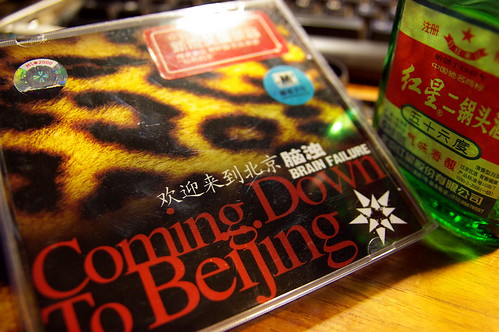
Brain Failure – Coming Down To Beijing / Call The Police

Tuesday, August 5th, 2008

Brain Failure - Coming Down To Beijing

Semaine du 5 août 2008 / Week of August 5th, 2008

Cette chronique hebdomadaire sur la musique indépendante chinoise est diffusée à Radio Centre-Ville (102.3FM), les mardis entre 22h30 et 23h30. L’émission complète est disponible sur ce fichier MP3, à partir du lendemain de l’émission.

This weekly segment on independent Chinese music is broadcasted every Tuesday between 10:30PM and 11:30PM on Radio Centre-Ville (102.3FM). The full-length show is available at this MP3 file, starting from the day following the show.

***

1. Coming Down To Beijing
2. Call The Police

Maybe I chose these songs because they were sung in English, or maybe because it was the Olympics starting next week… But no, it’s only because they happened to be on my playlist. I am not naturally a fan of loud punk bands, not in English, or French or Chinese. Occasionally, I’ll hear something punky that I like, or be recommended a band, like this week’s Brain Failure, perhaps one of the best-known bands to come out of Beijing (they toured the US and Europe).

So, the first song, Come Down To Beijing, which is what the world is going to do on Friday. Secondly, Call The Police, because it is a really good energetic song.

(In fact, if you decide to listen to my segment on the radio, you might find, if you comprehend Cantonese, that I don’t say any of that, just because.)

We hope that the first song topic will happen smoothly, and that they won’t need to get to the second (ha-ha).

(Oh yeah, there is also this song called KTV on the same 2007-released album – with Modern Sky. On the album’s sleeve, the lyrics say “He ask me won’t you get some push for me”, whereas on the web – and what you can parse from the song – it’s “He ask me won’t you get some pussy for me”. Identically, someone changed “Won’t you suck my dick in the KTV” for “Won’t you see my daddy in the KTV”…)

À l’heure de la Chine, sur Radio-Canada

Monday, August 4th, 2008

Tiens, tant qu’à parler de Radio-Can… La SRC présentera au cours des Jeux Olympiques, à la télé et sur le web, une série de reportages « À l’heure de la Chine » réalisés par six de ses anciens ou présent correspondants à Beijing.

Ce midi, à la Première Chaîne, Jacques Beauchamp sur La Tribune (lien pour écouter l’extrait à droite) recevait Raymond Saint-Pierre, Jean-François Lépine et Michel Cormier, pour recevoir les questions d’auditeurs. Alors que sur le carnet à Cormier, les commentaires vont dans tous les sens (et c’est peut-être la nature du web), les intervenants à la radio furent surprenamment bien informés et nuancés. La question la plus intéressante, je pense, venait d’un jeune homme qui se demandait, en citant Adbusters, ce qu’en fait la Chine pensait de l’Occident, en inversant le sujet de comment gérer « montée de la Chine » pour parler que des gens pensants en Chine se questionnant maintenant sur le déclin de l’Occident! (vers la 21e minute)

Fait saillant aussi, s’il en est un, M. Beauchamp qui joue à l’avocat du diable en défiant M. Cormier sur le portrait négatif des médias sur la Chine!

Ensuite, je vous suggère fortement de lire le blogue de Catherine Mercier sur Radio-Canada.ca. Recherchiste-chroniqueuse pour Une heure sur terre, elle parle une coupe de langues, dont le Chinois – mieux que moi, pour avoir enseigné l’anglais dans une école internationale à Beijing en 2006-07. Donc, attendez-vous à une journaliste enthousiaste qui connait bien le pays!

Finalement, pour s’auto-ploguer, je viens de remettre un article sur la scène musicale pékinoise à être publié ce vendredi sur le blogue de Bande à part (voir ces deux articles que j’avais publié sur CLC à propos de Beijing durant mon voyage). Pour ceux qui ne le savaient pas, l’histoire de la musique rock dans la capitale chinoise remonte à au moins le milieu des années 80, et est tout à fait un aspect de la ville à découvrir (et on dit que c’est particulier à Beijing, car Shanghai et Hong Kong, il y a certainement une scène, mais c’est pas très fort).

Mise à jour 2008-08-12: Voici mon article publié par BAP sur la scène rock à Beijing.

De l’activité physique publique pour les Pékinois

Wednesday, July 16th, 2008

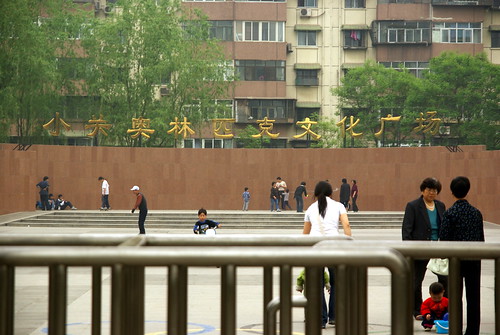
小关奧林匹克文化广场

Un article que j’ai composé pour Spacing Montréal a été repris par Spacing Toronto hier, notre publication-mère. Vu l’intérêt suscité, le voici traduit en français.

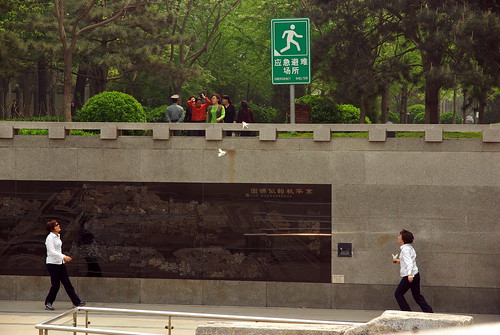
Megan Hall, la correspondante de Spacing Toronto à Beijing cet été vient récemment de signer un article très intéressant sur l’équipement d’activité physique publique dans les parcs et terrains de jeux de Beijing. En avril dernier, je suis resté deux semaines à Beijing, et ai pu moi-même découvrir comment les Pékinois investissaient leurs espaces publiques pour se garder en forme. L’article de Megan m’a d’ailleurs inspiré à parcourir ma collection de photos.

Kicking shuttlecocks outdoor in Beijing

Par exemple, une activité populaire, qui peut être pratiquée simplement sur le coin d’une rue ou un square publique possédant une surface plate assez grande, est de botter des volants (comme on joue au aki ici). Les gens que j’ai croisé dans les diverses instances en train de jouer ressemblaient à des employés de bureau ou de magasin prenant une pause.

Outdoor ping-pong

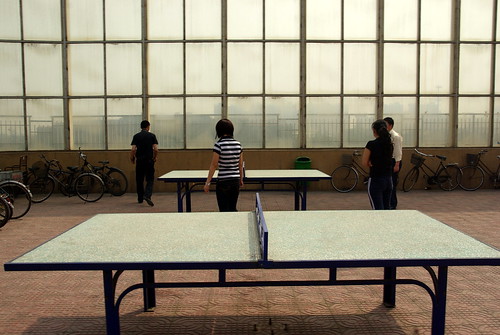
Vu que le ping-pong est un sport si populaire en Chine, ce n’est peut-être pas surprenant de retrouver des tables pour jouer à l’extérieur, comme sur cette photo prise dans un espace publique près d’un complexe résidentiel.

Beijing

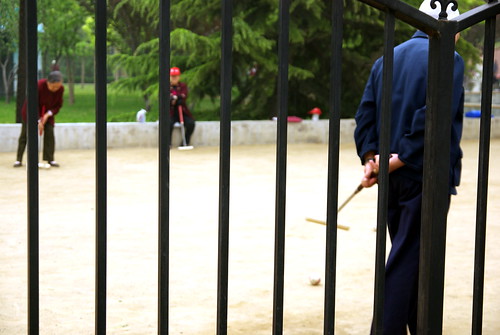
Dans cet autre parc, à juste quelques centaines de mètres du site olympique principal, quelques personnes du troisième âge jouent au croquet entre eux. Le terrain de jeu en question a l’air d’avoir été rénové récemment.

Carsick Cars: Zhongnanhai 中南海

Tuesday, July 8th, 2008

Carsick Cars (eponymous)

Semaine du 7 juillet 2008 / Week of July 7th, 2008

Zhongnanhai 中南海, by Carsick Cars.

On tonight’s show (from 22:30), I am presenting a song from Beijing band Carsick Cars. Whoever I hung out with, locals or expats, the name of this band would always come up in conversations. They are apparently appreciated the most by foreigners, for whatever reason. Are dubbed the Sonic Youth of China (having toured with them in the past).

Zhongnanhai (中南海) is perhaps their most well-known song. Fans throw cigarettes on stage whenever this song is performed live in a show. It primarily refers to a Chinese brand of cigarettes called the same thing, as sung in the song (“Who the hell smoked my Zhongnanhai”), and if you bend it, may refer to the place where Chinese leaders live (sort of their equivalent of the White House). Literally, Zhongnanhai means “Middle South Sea”, which is in fact a lake in Central Beijing, just 200m south-west of the Forbidden City.

Beijing Subway / Le métro de Beijing / 北京地铁

Wednesday, June 25th, 2008

北京地铁 Beijing Subway

北京地铁 Beijing Subway

北京地铁 Beijing Subway

北京地铁

Beijing Subway

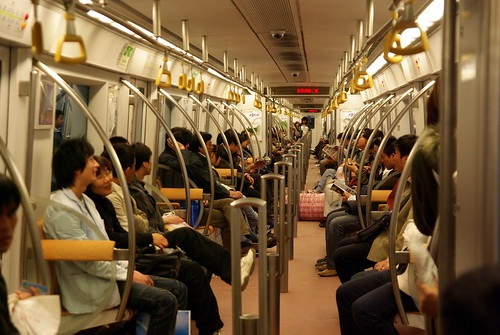
From Beijing, back in April, I wrote an article for Spacing Montreal on the Beijing Subway during rush hour, at the Xizhimen interchange. Here are some of the many pictures that I took on the subway, perhaps the only moment of daily rest (the distance between stations is so long in Beijing) that I had during my stay in the Chinese capital.

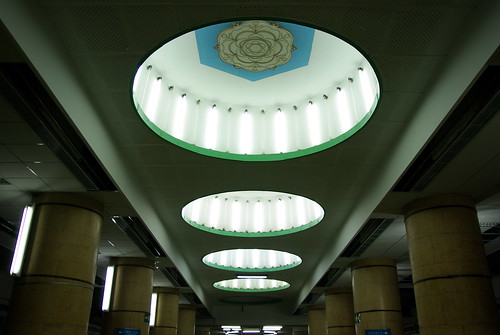
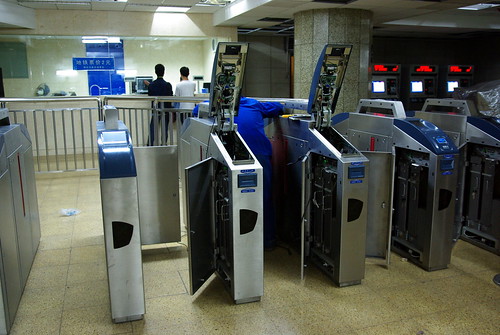
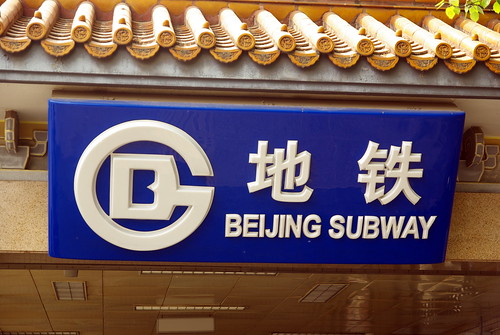
The first photo shows the ceiling over the platform area of a station on Line 2, part of the original system inaugurated in 1969. The second and third pictures were taken on one of the new trains occasionally running on Line 1. Photo four are the new turnstiles that were finally put for use in early June 2008. The last photo was taken outside of the Tian’anmen East (天安门东) station on Line 1.

***

De Beijing, en avril, j’ai écrit un article pour Spacing Montreal sur le métro de Beijing à l’heure de pointe, à l’échangeur de Xizhimen. Voici quelques photos que j’ai prises sur le métro, sans doute le seul moment quotidien de repos (c’est tellement long entre les stations à Beijing) durant mon séjour dans la capitale chinoise.

La première photo montre le plafond au-dessus des quais d’une station sur la ligne 2, faisant partie du parcours original inauguré en 1969. La deuxième et troisième photo ont été prises sur l’un des nouveaux trains qui roulent sur la ligne 1. Photo numéro quatre sont les nouveaux tourniquets qui ont finalement été activés, début juin 2008. La dernière photo fût prise juste à l’extérieur de la station Tian’anmen Est (天安门东) sur la ligne 1.

Tourists at Tian’anmen

Friday, May 2nd, 2008

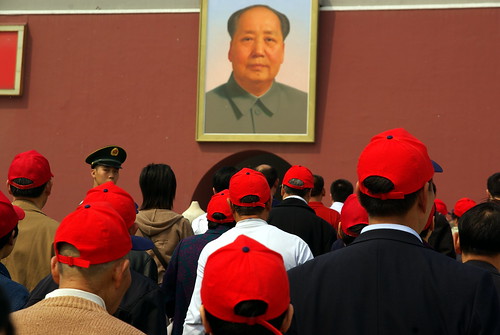
Mao and red caps

Lisez la suite de cet article / Read the rest of this entry »

The Linked Hybrid in Beijing

Tuesday, April 29th, 2008

Linked hybrid in Beijing (under construction)

Last weekend, I was given a tour of the Linked Hybrid’s construction site out in Dongzhimen, to the northeast of Central Beijing. Designed by Steven Holl Architects, the Hybrid is a 8-tower habitation complex, complete which outstanding feature is a “link” of bridges connecting the towers at the 20th floor. These structures will be public spaces: shops, cafés, and even a swimming pool.

The Dongzhimen (东直门) hub sees the 2nd ring road traverse it, is a interchange section for subway lines 2 and 13, and will become the city-side terminal to the new Airport Express to be inaugurated just before the Olympic Games. 1.5km away from Donzhimen is the Sanlitun Embassy Area, making the Hybrid an even more attractive choice for Beijing’s class of international dwellers.

The Hybrid is a scheduled for completion in August 2008.

Flickr set of the walk

This article was originally posted on Spacing Montreal.

Mechanized street sweeper on Guloudajie

Tuesday, April 29th, 2008

Mechanical street sweeper in Beijing

Seen near Guloudajie and the Drum Tower, close to Houhai as well.

Eggs are so fresh in Beijing…

Tuesday, April 29th, 2008

Eggs and shit

That they still have bird shit all over them. This picture was taken last week, when I bought groceries from the nearby mom and pop shop and cooked for myself, but I also just came back this afternoon from one of Beijing’s cleaner fresh food markets, the Sanyuanli, in Chaoyang, in eastern/central Beijing. It will be covered more in depth once I get to process my pictures.

All the magazines you will ever want

Monday, April 28th, 2008

Newsstand on Xidan
Newsstand on Xidan, Central Beijing

Perhaps you would think that Beijing is an international city, and that you could easily find newspaper stands or bookstores to hold your favourite magazines. I pretty much gave up on it, a week and a half in Beijing. I knew that in a Chinese-language speaking city, there is not much incentive to hold expensive, foreign-imported magazines (where one copy of the Economist equals 35 times the price of the China Daily’s English edition).

Lisez la suite de cet article / Read the rest of this entry »

Checking bus routes on Gulou Dongdajie

Monday, April 28th, 2008

Checking bus routes on Gulou Dongdajie, Beijing

Taken yesterday in front of the bus stop near Nanluoguxiang, on Gulou Dongdajie

This is the stuff that you drink in Beijing

Monday, April 28th, 2008

Red Star 紅星

In Beijing, you have two main choices in terms of domestic drinks. Either the watered down beer, usually Tsingtao or Yanjing in Beijing, or baijiu (literally something like “white wine” or “plain liquor”). Baijiu is a 50-60% alcohol per volume, stronger than the vodka we have at home, and would be intriguing to include in any type of cocktail.

This particular brand of baijiu here above, Red Star, is probably the most commonly found/purchased in Beijing. It is an erguotou, an inexpensive type of baijiu.

New Bang's presents spankin' rock/electro concert at Beijing's 2 Kolegas

We saw a bottle of the stuff on a poster of a show in town this past Saturday at the 2 Kolegas bar out in Chaoyang Park. It was a rock show with Joyside, Carsick Cars (both big names), Recycle and Shaka, with an electro (yes, they mix these in China…) set by Sulumi and DJ Dayong.

We are asking ourselves: is Red Star to the Beijing hipster what Pabst Blue Ribbon is to the North American one?