Tai Hang 大坑: the hippy valley

2010-01-31 | Cedric Sam

Tai Hang 大坑

Tai Hang 大坑

After spending part of my Sunday afternoon two weeks ago exploring Tin Hau and Fortress Hill, I set out to another area that was kind of a black hole to me on Hong Kong Island: the enclave of Tai Hang (大坑) near Victoria Park.

Previously, I only knew Tai Hang, as the name for Tai Hang Road, leading up to the mountain which forks into the “Tai Hang” drive (now with an opulent new development called The Legend). However, this does not represent Tai Hang proper, as the “real” Tai Hang is in fact a valley accessible by road only through Tung Lo Wan Road from the north side.

If you know the Hong Kong Central Library, then you can locate Tai Hang as being towards the mountain, a tad to the east. It’s out of everyone’s way, a 10-minute walk from Tin Hau MTR.

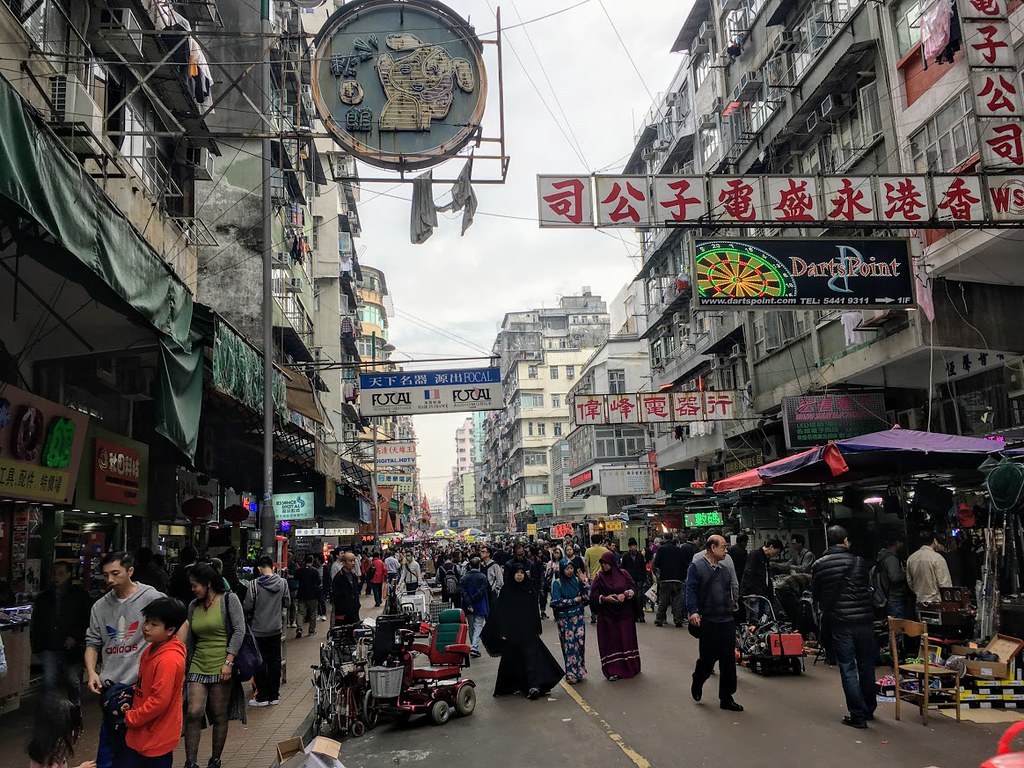
Tai Hang is perhaps also a remarkable spot because it is very slightly built-up, with relatively narrow streets and little traffic. From what I gather, listening to relatives who lived there, or people of my age living in nearby areas, many of the new businesses opened shop only in the past few years, with the neighborhood’s increasing gentrification. To the north of Tai Hang, closer to Tung Lo Wan Road, trendy bars go elbow-to-elbow with fashionable clothing stores and cute dessert houses.

As you walk further to the south, inside the valley, not only does it get darker (because of the taller nearby buildings on Tai Hang Road), but also the “interesting” businesses aforementioned tend to diminish, replaced with motor shops that service taxis and expensive vintage vehicles alike.

Lisez la suite de cet article / Read the rest of this entry »

A stroll on Electric Road, from Tin Hau to Fortress Hill

2010-01-30 | Cedric Sam

Tin Hau 天后

Tin Hau 天后

Two weeks ago, I set out to Tin Hau MTR for a walk in a new random neighborhood that I did not know. When I came to Hong Kong in 2008, I stayed in North Point, with Causeway Bay as one my frequent hangouts, as it is for a lot of returning overseas Chinese. You can either take the tram or the MTR from North Point towards the more popular/international neighborhood to the west. In between North Point and Victoria Park are two MTR stations which eventually lent their names to the neighborhoods they serve: Tin Hau and Fortress Hill.

One is named after a temple to the Chinese deity Tin Hau, and the other took its name from, well, a hill with a fortress on it (although I’ve never seen it). On the mountain side of TH and FH is a relatively well-off high-rise residential area.

AIA Tower

Closer to the sea, around the MTR station and the main arteries of King’s Rd and Electric Rd, lie some more popular apartments. The neighborhood is clearly gentrifying because of the proximity to Causeway Bay and relatively new office skyscrapers around Fortress Hill MTR like the AIA Tower (1999) and the Manulife Tower. While walking on Electric Rd, close to Tin Hau, you would recognize a strip of mid-scale, clean-looking Southeast Asian restaurants.
Bakery in Tin Hau 天后

Bread

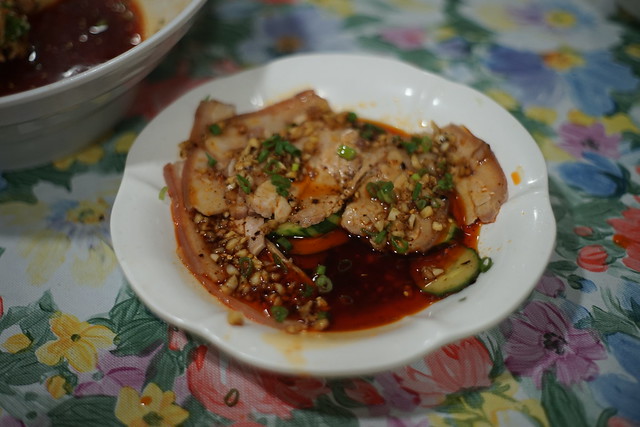
Maybe one-third on my way from Tin Hau to Fortress Hill, along Electric Rd, I stumbled upon a bakery, which was by no means fancy, but had a lineup in front of it, while the staff scurried to provide with freshly baked egg tarts, pineapple cakes — I had one of those and it was very good, especially warm, fresh out of the oven. I also bought a loaf of bread, eight slices for cheaper than Garden bread, and also straight out of the oven.
Tin Hau 天后

IMGP3024

As I progressed north, half-way there to Fortress Hill MTR, I passed by a street of motor shops, at the ground floor of old manufactures, probably transformed into office space today.

Loving Hut: Vegan food in Hong Kong

2010-01-29 | Cedric Sam

Loving Hut - Vegan food in Hong Kong

Disclaimer: I am not vegan, let alone vegetarian. But my friend Kim, who happens to be vegetarian, was in town a few weeks ago. Often I would take the tramway from Central to Causeway Bay, and notice this shiny, flashy new fast-food restaurant along it in Wan Chai on same block as the gas station. The restaurant is called Loving Hut and is in fact a chain originating from Taiwan, but with branches all across the world.

Kim told me that the Chinese-style fake meat she gets in Montreal is often imported from Taiwan. In the Buddhist tradition, followers would have these “vegetarian” days, which I know as “sek zai” (my grand-mother would do these once a week or so, and have tofu-based meals for an entire day).

Just like at a Maxim’s or Cafe de Coral, you must order from a menu next to the cashier. Then, you pick up your receipt and present it to the kitchen counter.

When I went for the first time, I had red rice with mini tofu cubes. Now, I probably ate or saw this dish before in its full-meat version. The vegan version was no less tasty (maybe a bit salty) and I would definitely have it again.

Loving Hut - Vegan food in Hong Kong

Loving Hut - Vegan food in Hong Kong

I also had a lemon basil seed (?) drink, which was served warm, and tasted sour with translucent seeds collecting at the bottom of the cup. There were char siu buns too without the char siu.

On a different occasion, now with three other friends, none vegetarians, we tried a larger variety of dishes. One was a classic yu hsiang eggplant, just without the ground pork. And then there was a bunch of noodles and a sweet and sour fried tofu.

===

A days after Loving Hut, we went again for vegetarian food, but this time in a real sit-down restaurant. It’s called Gaia Veggie Shop and is situated in Goldmark, right by the south side of the Sogo intersection in Causeway Bay, in the building next to the empty lot (old Mitsukoshi).

My photos are super low-res, so I am not going to post them. It’s good to know that the goal of this restaurant seems to be to fool you as well as possible. I never had fake sushi fish before, but let me tell you that it practically has the same texture, The menu in fact never specifies that such and such meat is “fake”, and dishes are always simply listed with meat names in it (only that you won’t find any meat in the actual order). Thinking about what we ate already makes me hungry… Aside from the sushi, we had a broth served in a coconut, and beef-wrapped enoki mushrooms. There was perhaps a sweet and sour chicken in there as well.

Promenade dans Central un vendredi soir tranquille

2010-01-15 | Cedric Sam

Traffic on old bailey street, central.
Congestion sur Old Bailey Street 奧卑利街

IFC mall, Hong Kong
IFC mall

2ifc vs. MTR
2 International Finance Centre 國際金融中心二期 et Hong Kong Station

lamma island ferry pier in central
Entrée du quai des traversiers pour l’île de Lamma

Bakery renewal or when urban renovation goes through the stomach

2009-01-03 | Cedric Sam

Pâtisserie chinoise La Légende - Quartier Chinois / Chinatown Montréal
Pâtisserie La Légende 麗晶餅屋 undergoing renovations

Pâtisserie Callia - Quartier Chinois / Chinatown Montréal
Pâtisserie-restaurant Callia (嘉莉/麵包茶餐聽)

Quartier Chinois / Chinatown Montréal
Side of Pâtisserie Harmonie 麵包蜜語

Whereas the Chinese “food scene” (you can hardly call it a food scene when a city lacks quality Beijing and Shanghai cuisine) in 2009 has been dominated with the arrival of numerous restaurants and eateries opened by Mainland Chinese immigrants in Montreal’s new Chinatown, that of the traditional Chinatown on De la Gauchetière (between St-Urbain and Clark) was mostly revamped in the past two years with new Cantonese-owned shops, three of which happen to be bakeries.

Already in the winter of 2008, Harmonie (麵包蜜語) shook Montreal’s Chinese bakery standards by opening at the corner of St-Urbain and De la Gauchetière. Buns left to die on a colourless counter were a thing of the past. Now, Chinese pastries and other bite-size delicacies or cakes would be served in a decor on par with at least what you would see in Hong Kong or other larger Chinatowns of North America: lit-up counters, uniformed staff, floral decorations.

A year later in April 2009, a first competitor Restaurant Callia (嘉莉) was opened (by the family owning Chinese restaurant Keung Kee) across the street. It added the dining space and kitchen that Harmonie did not have, serving Hong Kong’s famed Cha chaan teng-style food of milk tea, beef brisket noodles and Italian noodles in Cantonese sauce, under big TV screens spouting soaps from TVB.

Now on my last visit of Chinatown during the Holidays, I noticed that my grandparents’ favourite (and personal longtime favourite, for lack of anything else) M.M. Légende took over the trendy “Asian-style” clothing store next door and hid behind wooden planks as it is undergoing renovations. For the past two years, I believe that it was to become the first casualty of the Callia/Harmonie combination. So instead, it renamed itself as Pâtisserie La Légende (麗晶餅屋) and decided to expand. Follow-ups would be greatly appreciated!

Maybe now this first casualty would be Dobe & Andy (right under of Kam Fung) if they don’t change. I’m now curious to see what is going to happen with this new huge space for a cha chaan teng, in spite of more restaurant space made available with the imminent inauguration of Plaza Swatow (長盛廣場).

Saturation, or serious signs of Chinese Montrealers moving back to Chinatown? My opinion is that this will largely depend on affordable parking space made available in the area from the Swatow building. Right now, paid parking is prohibitively expensive (no incentive as in downtown Montreal) and free spots can only be found four or five blocks away. A pleasure for nearby residents and public transit users, but a chore for a certain class of car-going suburbanites that I grew up with…

De la Gauchetière - Quartier Chinois / Chinatown Montréal

A last time raving about Montreal’s Chinese food

2009-12-28 | Cedric Sam

Dumplings at Qing Hua, Montreal

Dumplings at Qing Hua, Montreal

For some reason that evades me, good local Northern Chinese food is a rarity in Hong Kong, where wonton noodles, curried meat soup and Chinese rotisserie dominate the local fast-food landscape. You won’t find roujiamo in a street food stall, while fried tofus, squid, eggplant, or egg tarts, and other pineapple buns are everywhere. (You might also easily find upscale-ish Shanghai or Beijing restaurants in Hong Kong.)

So I made sure that as a must-have meal in Montreal, as I’m spending the Holidays here, among smoked meat and bagels (although no time for poutine), I would eat dumplings, Northern-style. One of Montreal’s prime locations for dumplings is Qing Hua Yuan. They were on St-Marc when they opened last year, but reopened this Fall on Lincoln, close to St-Mathieu in our Chinatown Two, near Concordia University.

The boiled dumplings are nothing special, but now the steamed ones! In contrast to their boiled counterparts, they perfectly conserve their full taste, and if you are a connoisseur of food, you would be careful to pierce your dumpling, savour the broth inside, before engulfing the rest of the jiaozi. The flavours seem to have expanded by a bit (any combo of pork, lamb, chicken, eggs, vegetable, anise, coriander, Chinese cabbage, etc.), on top of the surprising fried dumplings. Extra goodness: the taste of the reed coming from the steamer.

The fried ones (see second picture of this post) are served with a fine film, which I am guessing comes from a dried-up flour mixture, which in itself puts up a nice show.

Unfortunately, they only staffed one person to take care of the whole floor at lunchtime (it was the Holidays though), and cooled-off dumplings and unusually slow service (one hour from sitting to getting meal at lunchtime) were the resulting minus points. On the other hand, they thought of giving shrimp chips as a free-of-charge snack now, like they would give bread in a European restaurant, because steamed dumplings usually take 25 to prepare.

But is not cheap. On my second time there, with my parents at dinnertime, we needed four portions to be full (depending of flavour, steamer/plate is $8-13, + taxes/service). But hey, you’re paying for hand-made top-quality dumplings.

Qing Hua Dumpling, (438) 288-5366, 1676 Ave Lincoln, Montreal, QC H3H

Halal dim sum in Hong Kong

2009-12-18 | Cedric Sam

Halal dim sum in Hong Kong

Halal dim sum in Hong Kong

Halal dim sum in Hong Kong

IMGP1348

Menu - Halal dim sum in Hong Kong

Not too far of a walk from Wan Chai MTR station on Hong Kong island, you will find the Islamic Centre Canteen on the 5th floor of a muslim religious centre. People come to the Masjid Ammar and Osman Ramju Sadick Islamic Centre to pray, but also to enjoy good halal Chinese food. How can you have dim sum without pork, one might ask.

We ordered a generous variety of dim sum classics such as har gow, siu mai (w/o pork, eh), cheong faan and lo mai gai, and were able to get out of there for HKD30 (CAD4) each. Normal: the “big” (most expensive) dim sum were priced at only HKD12. I must say that it wasn’t the best dim sum I ever had in Hong Kong, but it was decent enough. It is featured in the Hong Kong tourist guide for people of muslim faith, and we noticed a number of people from Southeast Asia.

Islamic Centre Canteen. 5/F, 40 Oi Kwan Road. Wan Chai, Hong Kong, 2834 8211. Business Hours: 9:00a.m.10:00p.m.

Weekday morning in Lamma

2009-12-13 | Cedric Sam

Wet market in Yung Shue Wan, Lamma Island

Some things, you won’t see if you only visit Lamma on the weekends, or simply wake up too late. You might not see some of the fresh meat shops, that seem to be open early in the morning, or the fish market, which is only there up until 9am (and around 4pm in the weekdays).

The Yung Shue Wan “fish market” (because it’s like two vendors in what would be a small parking space for less than two mini-trucks) is located beside the Waterfront bar, close to the small pier for fishing boats opposite the main ferry pier, in the same bay.

Weekday morning in Lamma

Weekday morning in Lamma

Weekday morning in Lamma

Weekday morning in Lamma

Weekday morning in Lamma

The morning hour of commuting is always a bit of rush for me, a normally evening person. But I also enjoy taking the time to walk to the pier, rather than jog (or sometimes sprint) to it. I come out ten minutes earlier and pay more attention to my surroundings.

Yung Shue Wan, the village near the ferry pier, and largest village of Lamma Island, is completely different depending on the times you visit it. It’s, as you can imagine, a lot like a jungle or any ecosystem, at different times of the day, with a changing fauna and flora.

At night, you will see the night-dwellers come out, enjoying drinks under a starry night. In the weekend, tourists take over Lamma, and “normal life” hides under the cover (for instance delivery trucks are forbidden in Yung Shue Wan on weekend afternoons). And in the morning, vendors that you never see at other moments of the day suddenly appear: the guy who sells DVDs, the lady who sells her freshly picked veggies, and the meat/fish merchants.

Weekday morning in Lamma

Le jour et la nuit

2009-12-07 | Cedric Sam

IMGP1673

IMGP1679

Photos prises du sky garden de Queen’s Garden, Mid-Levels, durant le party de Québec Contact, le club social québécois de Hong Kong.

Not quite there yet

2009-12-06 | Cedric Sam

Outside Exchange Square

Outside Exchange Square

Outside Exchange Square on a (early) Sunday morning

This is an unfamiliar sight on a Sunday morning in Exchange Square, in Central, Hong Kong. Normally, these are prime spots for Filipina maids to take on the only day off of the week for many of them.

In Hong Kong, Central (and Victoria Park too) is known as the hang-out places for domestic helpers, who otherwise live with their employers. You can picture it as Hong Kong’s financial heart being transformed into a sort of outdoor bazaar.

The note to make is that it was barely 8AM when I took this picture this morning, which explains everything. However, you could already see a few people preparing their spots, or at least reserving theirs.

Stephen Harper in China — who (in China) cares?

2009-12-05 | Cedric Sam

Stephen Harper arrived in China on Wednesday, December 2nd, but it’s almost as if he did not. In Hong Kong at least, only official media (the China Daily) seems to be aware that our Prime Minister is visiting China on an official foreign mission — and they weren’t even cordial about it, criticizing him for not coming earlier.

What was in the Hong Kong papers today, December 4th, which concerns with the Prime Minister of Canada (with its 1.3 million-strong Chinese minority) visiting China? In the South China Morning Post, we have an article at the bottom of page A6, the last national news page:

SCMP (Friday, Dec 4, 2009)

Sino-Canadians leaders seal deals, including one on climate change

And flipping through Ming Pao and Sing Tao for a photo of Harper or mention of the characters “加拿大” (Canada), I found none and concluded that none of these major Hong Kong-based Chinese-language newspapers thought it was an issue as important as the two or three full pages to covering the Kam Nai-Wai saga, which saw new developments today.

In Thursday’s SCMP, the day after Harper’s stop in Beijing, there was also the puny A6 article, also taken from a press agency (despite the fact that the SCMP has a bureau in Beijing):

PM's visit to mend fences Canada broke: analyst

If we go back to the case of the China Daily, I must say that I did like most people in China and did not pick it up (it’s not a paper that people tend to read much). However, I did notice its signboard at the newsstand with the daily title, which had the word “thaw” in it if I remember well. This does contrast a lot with ecstatic treatment of Wen Jiabao’s visit to North Korea in October, or more recently, Obama’s visit to China (Obama being Obama, the news did cover page of many newspapers and fronted newscasts for most of the week he was here).

Other papers that had the choice chose not to cover Harper’s visit.

Critters of Hong Kong

2009-12-01 | Cedric Sam

Dog in carriage

People in Hong Kong love their dogs…

Pretty big spider

Bzzzzz

But if you live on Lamma Island, you might start encountering more unsavory species, such as giant spiders (crawling through your 3rd floor window), or gravity-defying mosquitoes.

On a Chinese scale

2009-11-23 | Cedric Sam

Chinese scale

Aside from having to adjust to a new currency, I sometimes need to deal with a new measure of weight, especially when buying groceries at the wet market.

The tael or loeng2 (両) is one such unit of weight, as seen on this scale. The catty or gan1 (斤) is perhaps the one unit that I hear of the most often when getting vegetable for instance. This is used commonly in small grocery stores (maybe big ones too) and in wet markets alike. A gan1 is worth ~604.8 g and ~1.333 lb, a measure in the same “Western” range of weighing in kg or lbs, which is generally used for consumer-quantities of food.

These are Hong Kong units of measurement, formed under the influence of the British imperial system.

Free stuff! (But you have to line up)

2009-11-22 | Cedric Sam

Lining up for samples

Lining up for samples

Lining up for free stuff is definitely one of those “strange things” taken from a North American perspective. Free stuff here is never taken for granted, and a line usually naturally forms without much external force.

People are very eager to get their free stuff, and this line (for shake-in flavoured chips from Japan?) stretched for a good 30-40 metre, under the rain…

Un autre « Obama-Jintao » et j’vais péter ma coche

2009-11-17 | Cedric Sam

JintaoJintaoJintao

Ah, ce sacré Jintao

Les gens qui ont écrit l’article possèdent probablement une meilleure connaissance des relations internationales, mais ça me choque à chaque fois de devoir me taper les prénoms à la place des noms de famille. En chinois, LE NOM DE FAMILLE S’ÉCRIT DEVANT LE PRÉNOM. Pis c’est pas si dûr de se rappeler la règle que le nom de famille est composé d’un seul caractère, et donc d’une syllabe.

Voilà qui est dit.

Votre serviteur a commencé à collaborer avec le centre de journalisme et d’études médiatiques faisant partie de l’Université de Hong Kong. Autrement connu sous l’acronyme de JMSC, cette école dont la langue d’enseignement est l’anglais se veut le point névralgique où se touchent les mondes médiatiques anglophone (international) et sinophone (chinois). Les profs qui y enseignent sont à la fois des vétérans journalistes de Chine continentale, de Hong Kong ou d’origine internationale (anglais, indiens, japonais, hongrois, américains, etc. — et c’est juste ceux que j’ai rencontrés), et des parcours non moins intéressants.

J’en parle, non pas par souci d’auto-promo, mais bien plutôt pour contribuer à faire connaître le nom de l’école, car celle-ci est en période de recrutement, pour ses programmes de 1er et de 2e cycle. La maîtrise en journalisme se veut un genre de MBA pour les gens en relations internationales, comm, et médias.

Donc voici le lien: http://jmsc.hku.hk/

C’est pas donné, de notre perspective québécoise de quasi-gratuité scolaire, mais ça en vaut franchement le coup d’oeil si on s’intéresse à la Chine.

Pis espérons-le que des grossières erreurs comme ci-dessus seront chose du passé… La Chine a l’air d’un pays lointain du point de vue du Québec. Pourtant, j’ai rencontré à maintes fois des Québécois qui vivent à Hong Kong et qui pognent à quel point ce pays multiforme, dynamique, devrait être mieux compris afin de vivre avec.